Tony Yang, sales manager at Unitree Robotics, introduces CEO and CTO Xingxing Wang’s G1 humanoid robot and discusses its design, cost, and intended uses.
Yang says Unitree considers the G1’s locomotion especially stable for a humanoid robot. He describes its actuators as having a wide range of motion, enabling postures that people cannot take.
Yang identifies the G1 as a general purpose robot. Compared with Unitree’s H1, it is smaller and has less powerful actuators, which he says can make it easier and safer to use in some settings. Unitree hopes to use it in manufacturing and service.
Yang says Unitree changed the robot’s appearance because it expects substantial interaction with people. Its smaller size is intended to help make it more affordable. He also credits Unitree’s motor and actuator sensor design, along with China’s manufacturing capacity, for keeping component costs low.
Yang argues that humanoid robots are well suited to embodied AI. He contrasts slower progress in humanoid robotics over the previous decade with rapid AI advances over the past two to three years, and says Unitree uses AI in its robot development to help address problems.
Briefs summarise talks and interviews; timestamps open the video at that moment. Claims in a talk are the speaker's own.
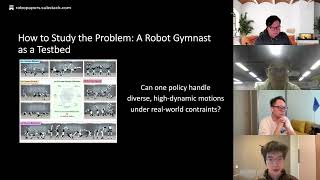
Yunshen Wang and Shaohang Zhu, paper authors from BIGAI and collaborating institutions including Unitree Robotics, discuss OmniXtreme’s approach to general high-dynamic humanoid control with RoboPapers hosts and audience.
PRO ROBOTS’ main presenter covers humanoid, service, industrial, and healthcare robots at China’s 2025 World Robot Conference, with demonstrations and interviews from exhibitors.
Sergey, host at Supercar Blondie, explores Unitree Robotics’ quadruped and humanoid robots at the company’s factory in China with Unitree representative Yolanda.
Light Origins’ presenter explains how Light-O1 uses human video to train robot action models and demonstrates it on a Lightwheel setup and a Unitree G1.
Joseph Amigo, a second-year PhD student, and Ruhollah, a fourth-year PhD student at NYU, discuss their paper on robot reinforcement learning with RoboPapers hosts.