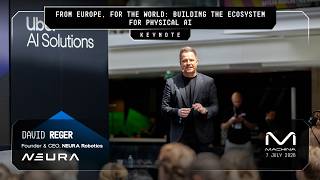
David, founder of NEURA Robotics, presents the company’s physical AI strategy at IFA Berlin’s Innovation Stage and answers audience questions about robotics, data, and work.
David says NEURA Robotics has about 750 employees, an order book above €1.5 billion, and a pipeline exceeding €10 billion. He describes a goal of reaching about €13 billion in revenue by 2030, arguing that robotics could help sustain Europe’s economy. He links growing interest in robotics to demographic change, citing an estimate of 120 million fewer workers across major economies by 2030.
David identifies time to scale as NEURA’s key measure. He says training a person for even simple physical work takes at least three hours, while NEURA reduced robot skill training from 50–60 hours to around 14 hours in three months and expected to reach three to four hours in another three. His example is that a trained robot skill can be copied across many robots, whereas people must be trained individually.
David argues that useful robots need multimodal sensors, computing infrastructure, and fast reactions as well as a capable AI model. He compares learning physical skills to swimming: watching or describing it is not enough; the learner must practice in the environment. NEURA is working with Qualcomm on a robotic “nervous system” and uses robot gyms where people can train tasks, including household work, welding, and gluing.
David says NEURA’s training gyms and platform are intended to let companies retain and monetize their own know-how. The Neuraverse platform connects robots with devices, cameras, and infrastructure, and can turn a picture of a room into a 3D environment for simulation. He describes AURA as an agentic AI layer that coordinates AI tools, while the platform can convert a requested task into a deployable node graph.
In the Q&A, David says robot learning can combine human demonstrations, tactile and other multimodal data, real robot data, and simulation, with the best mix still to be determined. He says data gathering and sensorization are the first adoption priorities, followed by computing and cloud infrastructure; he also describes anonymization measures such as blurring faces, tattoos, and voices. Asked about entry-level jobs, he points to workforce decline through 2030 and says society must decide how to manage longer-term effects.
Briefs summarise talks and interviews; timestamps open the video at that moment. Claims in a talk are the speaker's own.
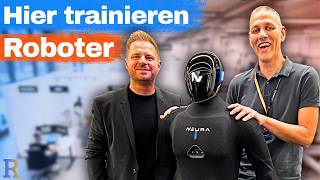
Jens Fischer, host of RoboSphäre, covers the opening of Neura Robotics’ robot training gym at Munich Airport with TUM, including remarks from Neura Robotics CEO David Reger and TUM representatives.
Neura Robotics founder and CEO David Reger explains his vision for physical AI and how the company is building robots, training tools and a shared platform at MACHINA 2026 with Machina Summit.
David Reger, founder and CEO of NEURA Robotics, discusses physical AI, robotics platforms, and open collaboration with John Furrier on SiliconANGLE theCUBE at Machina Summit in Paris.
Paolo Ardoino, CEO of Tether, discusses local physical AI, decentralized machine intelligence, and the potential for collaboration with NEURA Robotics in conversation with a NEURA Robotics host.