Humanoids Summit· Oct 19, 2026
Advanced Bionic Hands for Humans & Robots | Aadeel Akhtar (PSYONIC)
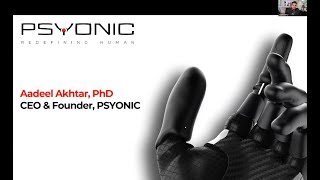
Aadeel Akhtar of PSYONIC presents at Humanoids Summit on bionic hands that serve prosthetic users and help robots learn manipulation tasks.
Dr. Aadeel Akhtar, CEO and founder of Psyonic, explains how the company’s bionic hands serve both prosthetic users and robots at the Humanoids Summit.
Psyonic designs its Ability Hand for use by both human prosthetic users and robots. Akhtar says people’s experience using the hand can help teach robots new tasks, pointing to a NASA demonstration where a user managed a wall zipper the robot had struggled with. He says the hand is in use with nearly 300 patients and more than 50 robotics organizations, including NASA, Meta, Google, Amazon, and Mercedes.
Akhtar demonstrates button control, while user Dale DeMasi describes operating the hand through muscle signals for daily activities, sports, and household tasks. Touch sensors in the fingers can send haptic feedback when an object is grasped or released. For robots, an open API provides finger position, speed, torque, and sensor data; the hand is designed to withstand impacts, and a damaged finger can be replaced in about 10 minutes.
Examples range from cooking and laundry to warehouse sorting and automotive assembly. Akhtar describes Mercedes using the hand on an Apptronik Apollo robot and a Berkeley study comparing a multi-fingered hand with parallel-jaw grippers on tasks such as handling cylinders and cooking. He also announces a Universal Robots integration through URcap and PolyScope X.
Akhtar calls Psyonic’s approach real-to-real transfer: a person uses the same type of hand as the robot to demonstrate a task, and that data can train the robot. As an example, Dale used the hand to serve mashed potatoes, and the team trained a Unitree G1 robot to repeat the action. Psyonic has a $2.6 million Department of Defense grant to develop nerve implants for finger control and touch feedback, with the goal of collecting more training data.
Akhtar shares how user Jamie Grochong, who lost his hand in a fireworks accident, returned to baseball with the Ability Hand. He says the device typically costs $10,000 to $20,000 depending on insurance, with a future target below $5,000 per hand at higher volumes. Psyonic is raising a Series A to expand production, develop new hands and arms, and build its robot training data efforts.
Briefs summarise talks and interviews; timestamps open the video at that moment. Claims in a talk are the speaker's own.
Aadeel Akhtar of PSYONIC presents at Humanoids Summit on bionic hands that serve prosthetic users and help robots learn manipulation tasks.
Dr. Aadeel Akhtar, founder of PSYONIC, discusses building the Ability Hand for people with limb differences and robots with host Chris on Manufacturing Happy Hour.
Dr. Aadeel Akhtar, CEO and founder of Psyonic, discusses bionic hands for prosthetic users and robots with Jeff Rick at Humanoid Summit 2024.
Dr. Aadeel Akhtar, CEO and founder of PSYONIC, discusses affordable bionic hands, patient needs, and future prosthetics with the Next Big Thing Podcast hosts.
Aadeel Akhtar, CEO and founder of Psyonic, describes building affordable, accessible bionic limbs at the Institute for Neural Computation and answers questions from its audience.
Light Origins’ presenter explains how Light-O1 uses human video to train robot action models and demonstrates it on a Lightwheel setup and a Unitree G1.