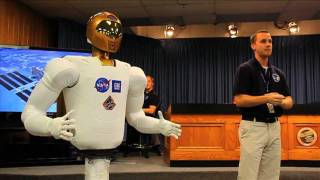
Rob Ambrose, acting chief of Johnson Space Center’s Automation, Simulation and Robotics Division, describes Robonaut 2’s design, safety systems, planned ISS experiments, and possible future roles alongside astronauts.
Ambrose traces about 15 years of development, from early arms and hands to a portable upper body with integrated electronics. NASA partnered with General Motors on Robonaut 2, building two units and testing R2B for flight, including a four-to-five-day bake at 120 degrees to check for harmful off-gassing.
Robonaut’s joints use spring-based actuation so the arms yield when pushed, and sensors monitor forces at several levels. The system can pause when it detects contact or shut down if force exceeds a higher threshold. Its hands combine force sensing, padded surfaces, palms, and programmable grasps; they can also feel an object’s shape and position a finger accordingly.
R2B was planned to arrive on a pedestal in the U.S. lab, with astronauts first checking its power-up and system health, then testing interfaces such as switches, valves, and latches. Ambrose identified zero-gravity manipulation as the main engineering objective. Candidate crew-support jobs included wiping handrails and vacuuming air filters; the robot would run scripted tasks with force responses handled automatically.
Ambrose described possible upgrades including legs for moving around the station and a new torso computer for work outside. A wheeled base called Centaur 2 could support surface exploration, while different lower bodies could suit different destinations. He outlined robots working ahead of crews, alongside them, or remaining behind to tend experiments; free movement would require a battery or another power source.
Briefs summarise talks and interviews; timestamps open the video at that moment. Claims in a talk are the speaker's own.
Dr. Brad Ambrose, former NASA humanoid robotics team lead and chairman of robotics at Alliant, discusses humanoid design, commercial potential, and U.S.–China competition with John Koetsier on NEXT.
Nicolaus Radford, founder and CEO of Nauticus Robotics, describes his move from NASA space robotics to autonomous underwater work at an IHMC lecture in Pensacola.
Rhonda Flirt, a NASA Johnson Space Center presenter, demonstrates Robonaut 2 with colleague Julia Badger, explaining how the humanoid robot works alongside people in space and on Earth.