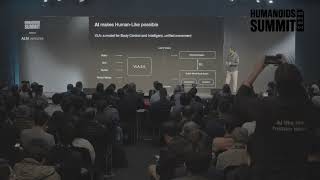
An XPENG presenter discusses Iron’s human interaction, multilingual conversation, memory, and question answering through demonstrations involving the G9L.
Iron uses coordinated head, waist, and leg movement to follow a person’s gaze. The presenter says its perception, vision, and motion control systems help it respond smoothly during interactions.
Iron is designed to follow a speaker’s language without requiring extra instructions. The presenter attributes this to a multilingual base model, post-training for more natural expression, and balanced multilingual training data.
Iron recognizes returning testers even after they change places and clothes. It combines facial and voice features with conversation details to build and update personal memory profiles, including preferences such as which car someone likes.
The presenter describes store guidance as an early use for Iron, where it should answer questions across different areas. The system uses three locally deployed Turing chips; the presenter also mentions 580 TOPS.
In response to a question about a family of five traveling with camping equipment, Iron says the G9L has over 1,100 liters of trunk space with all five seats occupied.
Briefs summarise talks and interviews; timestamps open the video at that moment. Claims in a talk are the speaker's own.
He Xiaopeng, chairman and CEO of XPeng, discusses the company’s humanoid robot Iron, robotics strategy, and how AI and engineering shape XPeng’s cars, with a host from MadeinChina.
An XPENG presenter discusses how the company designed its next-generation Iron humanoid to balance human-like movement and appearance with engineering constraints.
Robotics enthusiast Kevin Wood, who works in robotics and AI and runs a YouTube channel, discusses humanoid design and recent robot news with Devin on The Humanoid Hub.