Humanoids Summit· Oct 19, 2026
Advanced Bionic Hands for Humans & Robots | Aadeel Akhtar (PSYONIC)
Aadeel Akhtar of PSYONIC presents at Humanoids Summit on bionic hands that serve prosthetic users and help robots learn manipulation tasks.
Zuan and Shouting Drew, Project Instinct coauthors working on robotics hardware and learning algorithms, discuss humanoid whole-body control and their open-source research toolkit with RoboPapers host Jaffy.
Project Instinct brings perception, whole-body control, motion references, sensors, and real-robot testing into one toolchain. Its components are designed to be replaceable, so researchers can compare modules or use their own datasets without rebuilding the system. The authors invite the community to help develop reusable evaluation methods, since current humanoid metrics can be hard to measure consistently in real-world tests.
The research began with quadruped parkour, aiming to overcome obstacles larger than the robot, and later moved to humanoid parkour. The team found that humanoids need different terrain representations because their elevated cameras see stairs and platforms differently from a quadruped’s forward-facing view. They describe instinct-level behavior emerging when a policy learned to avoid risky jumps after experiencing failures in simulation.
The pipeline scans terrain, retargets motion-capture data, matches motions to terrain, and trains many robots in parallel. In tests, depth input helped the robot adjust when its starting position was shifted by as much as 0.5 meters, and it completed motions on unseen terrain. The team uses a forward stereo depth camera with a two-meter view; delayed frames from a weak USB connection sometimes caused jitter.
The team uses virtual obstacles and terrain edge detection to encourage safer, more redundant movements, such as jumping higher than a platform requires. Project Instinct also includes ray casting for crowded training scenes, several learning methods, multiprocess training, and deployment tools that read experiment settings from training logs. To support another robot, researchers can define its hardware configuration alongside the G1 configuration.
The guests frame humanoid locomotion as whole-body control that can include climbing, crawling, and using contact, with decisions about when to go over an obstacle or around it. They argue that hardware and software should be developed together, since hardware changes can improve performance but may trade flexibility for rigidity. They want more motion and terrain data, stronger sim-to-real reliability, and community contributions to shared robot configurations.
Briefs summarise talks and interviews; timestamps open the video at that moment. Claims in a talk are the speaker's own.
Aadeel Akhtar of PSYONIC presents at Humanoids Summit on bionic hands that serve prosthetic users and help robots learn manipulation tasks.
Light Origins’ presenter explains how Light-O1 uses human video to train robot action models and demonstrates it on a Lightwheel setup and a Unitree G1.
Joseph Amigo, a second-year PhD student, and Ruhollah, a fourth-year PhD student at NYU, discuss their paper on robot reinforcement learning with RoboPapers hosts.
Armin Foshnaughski of Munro & Associates, Schaeffler’s Al Mackie and Paul, and Scott Walter of RoboStrategy discuss the Unitree G1’s design and humanoid robotics during a Munro teardown.
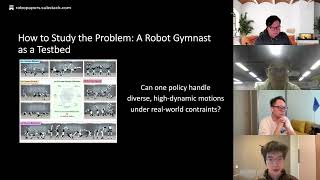
Yunshen Wang and Shaohang Zhu, paper authors from BIGAI and collaborating institutions including Unitree Robotics, discuss OmniXtreme’s approach to general high-dynamic humanoid control with RoboPapers hosts and audience.
Yash, a robotics researcher at NVIDIA, presents NVIDIA Robotics Research’s work on physical AI with Jim and Yu Khor at the NVIDIA Omniverse channel event.