Humanoids Summit· Oct 19, 2026
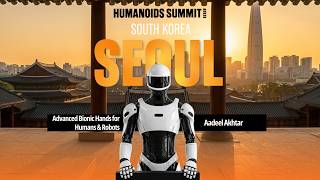
Advanced Bionic Hands for Humans & Robots | Aadeel Akhtar (PSYONIC)
Aadeel Akhtar of PSYONIC presents at Humanoids Summit on bionic hands that serve prosthetic users and help robots learn manipulation tasks.
Bong, a research scientist at BIGAI, explains sensor-free force and position control for legged robots and human-humanoid collaboration with the RoboPapers hosts.
Bong describes trying to make a Unitree robot wipe a whiteboard. Position-only teleoperation either applied too little pressure to erase marks or too much for the robot to follow the path. Legged robots often lack force sensors, and adding them can be costly and difficult.
UniFP models the robot as a mass-spring-damper system and estimates external force from the difference between commanded and actual position. It adjusts the position target to produce compliant responses, force tracking, or gravity compensation. The same idea can adapt a walking robot’s desired velocity when someone pushes or stops it.
The team trains a whole-body control policy in simulation with sampled position and force commands, external forces, and robot state histories. Bong says estimated forces were within roughly a five-newton range, which may be adequate for heavy lifting but too imprecise for delicate tasks such as holding an egg. Adding force information to imitation learning improved success by 39.5% over a vision-only Diffusion Policy.
For collaborative carrying, the team trains a whole-body controller, then a residual teacher that responds to an object’s movement and stability, and distills it into a student policy for deployment. In demonstrations, a person guides the robot by pulling it to move and pushing it to stop. Bong notes that autonomy remains limited and that command selection still needs work.
Bong identifies force estimation accuracy, position precision, and choosing between force and position commands as open problems. He expects several useful compliance levels to matter soon, while precise force estimation may take three to five years. Better sensors and faster feedback will be needed for demanding interactions such as juggling or delicate manipulation.
Briefs summarise talks and interviews; timestamps open the video at that moment. Claims in a talk are the speaker's own.
Aadeel Akhtar of PSYONIC presents at Humanoids Summit on bionic hands that serve prosthetic users and help robots learn manipulation tasks.
Light Origins’ presenter explains how Light-O1 uses human video to train robot action models and demonstrates it on a Lightwheel setup and a Unitree G1.
Joseph Amigo, a second-year PhD student, and Ruhollah, a fourth-year PhD student at NYU, discuss their paper on robot reinforcement learning with RoboPapers hosts.
Armin Foshnaughski of Munro & Associates, Schaeffler’s Al Mackie and Paul, and Scott Walter of RoboStrategy discuss the Unitree G1’s design and humanoid robotics during a Munro teardown.
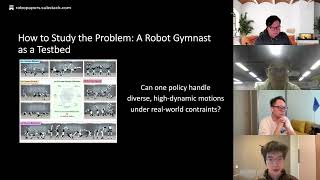
Yunshen Wang and Shaohang Zhu, paper authors from BIGAI and collaborating institutions including Unitree Robotics, discuss OmniXtreme’s approach to general high-dynamic humanoid control with RoboPapers hosts and audience.
Yash, a robotics researcher at NVIDIA, presents NVIDIA Robotics Research’s work on physical AI with Jim and Yu Khor at the NVIDIA Omniverse channel event.