Humanoids Summit· Oct 19, 2026
Advanced Bionic Hands for Humans & Robots | Aadeel Akhtar (PSYONIC)
Aadeel Akhtar of PSYONIC presents at Humanoids Summit on bionic hands that serve prosthetic users and help robots learn manipulation tasks.
Sang, a research scientist at BIGAI, and Isha, a BIGAI researcher, discuss CLONE, their whole-body humanoid teleoperation system, on RoboPapers with hosts Michael and Chris.
The researchers want humanoids to handle tasks at different heights, such as squatting to reach objects on the floor. They argue that current demonstrations often emphasize locomotion or scripted actions, while home and warehouse work requires interaction with objects throughout a 3D space. They see a shortage of whole-body interaction data as a barrier to training those capabilities.
CLONE uses an Apple Vision Pro to track the operator’s hands and head, providing three points to guide the robot’s 29 degrees of freedom. A teacher policy trained in simulation uses motion tracking and an adversarial motion prior; a distilled student policy with a mixture of experts is used for deployment. Global localization combines headset tracking with robot odometry from lidar, RGB-D, and an IMU to correct drift during extended operation.
The demos include squatting, walking while crouched, wrist movements, boxing, table tennis, handovers, and warehouse-style tasks. The team reports lower tracking error with a mixture-of-experts policy and better upper-body tracking when training with its CLONE motion data. That data included about 20 newly captured motion sequences, roughly a minute each, alongside about 130 AMASS sequences; the researchers distinguish this controller-training data from the much larger interactive datasets needed for autonomous policies.
The researchers see changing operating height as a potential advantage of humanoids over wheeled robots, but say terrain flexibility, including stair use, still needs development. They have not tested high-force tasks such as opening heavy doors, and note that the G1’s shoulder and elbow motors can overheat during extended operation. Future directions include more flexible control modes, larger models, dynamic tasks, and real-world data collection; operators also need to adapt to headset delay, especially for precise manipulation.
Briefs summarise talks and interviews; timestamps open the video at that moment. Claims in a talk are the speaker's own.
Aadeel Akhtar of PSYONIC presents at Humanoids Summit on bionic hands that serve prosthetic users and help robots learn manipulation tasks.
Light Origins’ presenter explains how Light-O1 uses human video to train robot action models and demonstrates it on a Lightwheel setup and a Unitree G1.
Joseph Amigo, a second-year PhD student, and Ruhollah, a fourth-year PhD student at NYU, discuss their paper on robot reinforcement learning with RoboPapers hosts.
Armin Foshnaughski of Munro & Associates, Schaeffler’s Al Mackie and Paul, and Scott Walter of RoboStrategy discuss the Unitree G1’s design and humanoid robotics during a Munro teardown.
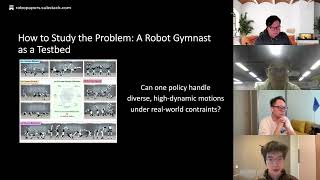
Yunshen Wang and Shaohang Zhu, paper authors from BIGAI and collaborating institutions including Unitree Robotics, discuss OmniXtreme’s approach to general high-dynamic humanoid control with RoboPapers hosts and audience.
Yash, a robotics researcher at NVIDIA, presents NVIDIA Robotics Research’s work on physical AI with Jim and Yu Khor at the NVIDIA Omniverse channel event.