Humanoids Summit· Oct 19, 2026
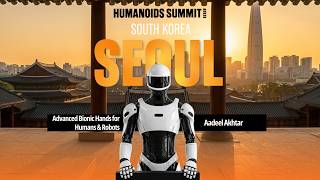
Advanced Bionic Hands for Humans & Robots | Aadeel Akhtar (PSYONIC)
Aadeel Akhtar of PSYONIC presents at Humanoids Summit on bionic hands that serve prosthetic users and help robots learn manipulation tasks.
Yan Han, an author of FALCON and an applied scientist intern with Amazon Frontier AI, discusses force-aware humanoid control with Flor and the RoboPapers audience.
Han says many humanoid projects focus on lighter tasks, while pushing or pulling objects creates difficult forces across both arms and legs. The goal was to keep walking stable and arm motion accurate despite unknown forces from different directions. He found that a single whole-body reinforcement learning controller struggled to balance those goals and needed more reward tuning.
FALCON trains separate upper-body and lower-body actor-critic policies together, with both using whole-body proprioception. During training, it samples forces within ranges calculated from the robot’s joint positions and torque limits. Han says the method trained in roughly 6,000 iterations, or two to three hours, and the same reward settings worked on Unitree G1 and Booster T1 robots.
In demonstrations, the robots resisted pulling forces, opened a door, and pulled a cart weighing about 85 kilograms. Han reports peak stance resistance of about 60 newtons and pulling resistance near 40 newtons. He also describes hardware constraints: a 3.7 kilogram bottle exceeded a wrist’s stated three kilogram torque capacity, and the robot could hold it only briefly before its motors softened.
The autonomous tote-carrying pipeline uses FoundationPose to locate grasp points, planning for the arm and walking motions, and FALCON for control. Han says the controller was trained on flat ground; stairs and other uneven terrain remain future work. Carrying heavy or shifting loads can also cause vibration, which the team had not yet resolved.
Han says FALCON uses no reference character and transfers from simulation to the robots. He recommends splitting arm and leg learning for stable locomotion while the arms track poses, but says whole-body training fits tasks such as football-like motion tracking better. He suggests applying a carefully designed force curriculum when adding disturbances to motion-tracking systems.
Briefs summarise talks and interviews; timestamps open the video at that moment. Claims in a talk are the speaker's own.
Aadeel Akhtar of PSYONIC presents at Humanoids Summit on bionic hands that serve prosthetic users and help robots learn manipulation tasks.
Light Origins’ presenter explains how Light-O1 uses human video to train robot action models and demonstrates it on a Lightwheel setup and a Unitree G1.
Joseph Amigo, a second-year PhD student, and Ruhollah, a fourth-year PhD student at NYU, discuss their paper on robot reinforcement learning with RoboPapers hosts.
Armin Foshnaughski of Munro & Associates, Schaeffler’s Al Mackie and Paul, and Scott Walter of RoboStrategy discuss the Unitree G1’s design and humanoid robotics during a Munro teardown.
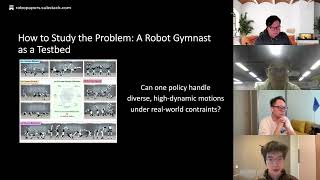
Yunshen Wang and Shaohang Zhu, paper authors from BIGAI and collaborating institutions including Unitree Robotics, discuss OmniXtreme’s approach to general high-dynamic humanoid control with RoboPapers hosts and audience.
Yash, a robotics researcher at NVIDIA, presents NVIDIA Robotics Research’s work on physical AI with Jim and Yu Khor at the NVIDIA Omniverse channel event.