Humanoids Summit· Oct 19, 2026
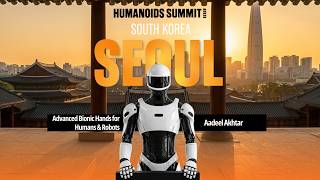
Advanced Bionic Hands for Humans & Robots | Aadeel Akhtar (PSYONIC)
Aadeel Akhtar of PSYONIC presents at Humanoids Summit on bionic hands that serve prosthetic users and help robots learn manipulation tasks.
Arthur and Hongsuk, UC Berkeley PhD students and coauthors of VideoMimic, discuss learning contextual humanoid control from human video on RoboPapers with the host and audience.
VideoMimic aims to teach humanoids terrain locomotion, stair climbing, and sitting or standing by learning from human demonstrations. The pipeline turns monocular video into a 3D scene and human motion, retargets that motion to a robot, then uses simulation to train a policy. The goal is to reduce reliance on manually tuned locomotion rewards.
The team records people with an iPhone and reconstructs both human motion and the static environment from video. They align an SMPL body model with scene point maps using 2D pose detections, then retarget the motion to a Unitree G1 and create a mesh for simulation. The authors describe limitations including noisy dynamic human point clouds, holes in reconstructed scenes, and a 30 to 50 percent pass rate for their own recorded videos.
Training begins with motion capture pretraining, followed by tracking roughly 120 video clips alongside terrain height maps. The team then distills the reference-conditioned tracker into a policy that uses a root direction command and terrain observations, followed by reinforcement learning fine-tuning. This lets a joystick command guide the robot without supplying a precise whole-body motion at every step.
The authors say the work demonstrates that scene-aware locomotion can be learned from video, rather than proving that internet-scale data already works. They tried internet videos but did not use them for training because reconstruction and curation were difficult; recording targeted clips was more reliable. They see richer depth input, more data, and improved reconstruction of dynamic motion as possible next steps.
Briefs summarise talks and interviews; timestamps open the video at that moment. Claims in a talk are the speaker's own.
Aadeel Akhtar of PSYONIC presents at Humanoids Summit on bionic hands that serve prosthetic users and help robots learn manipulation tasks.
Light Origins’ presenter explains how Light-O1 uses human video to train robot action models and demonstrates it on a Lightwheel setup and a Unitree G1.
Joseph Amigo, a second-year PhD student, and Ruhollah, a fourth-year PhD student at NYU, discuss their paper on robot reinforcement learning with RoboPapers hosts.
Armin Foshnaughski of Munro & Associates, Schaeffler’s Al Mackie and Paul, and Scott Walter of RoboStrategy discuss the Unitree G1’s design and humanoid robotics during a Munro teardown.
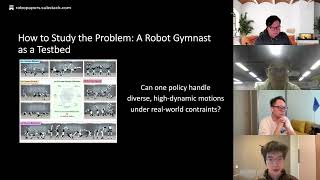
Yunshen Wang and Shaohang Zhu, paper authors from BIGAI and collaborating institutions including Unitree Robotics, discuss OmniXtreme’s approach to general high-dynamic humanoid control with RoboPapers hosts and audience.
Yash, a robotics researcher at NVIDIA, presents NVIDIA Robotics Research’s work on physical AI with Jim and Yu Khor at the NVIDIA Omniverse channel event.