Al Rizzi of the RAI Institute discusses machine learning for robot mobility and manipulation, including work with Boston Dynamics and examples presented at an IEEE Robotics and Automation Society event hosted by Kim.
Rizzi says useful robots must navigate unfamiliar places, interact with objects with human-like dexterity, understand instructions without requiring a team of specialists, and operate safely. He points to factories, cities, homes, and his sloped Vermont farm as settings that put these capabilities to the test.
The RAI Institute uses reinforcement learning and simulation to coordinate movement and physical interaction. In collaboration with Boston Dynamics, its team trained Atlas behaviors from motion-capture demonstrations and Spot behaviors from animator demonstrations, then transferred the resulting policies to the robots without further hardware training. Rizzi also shows the Institute’s UMV, a bicycle-like robot, and Roadrunner, which can shift among wheeled and bipedal modes.
A Spot robot with a Boston Dynamics arm drags one tire into a circle and stacks another on top, using its legs and body as well as its arm to handle tires whose mass is comparable to the robot’s. Reinforcement learning and planning combine short-horizon actions into the longer task, while the robot resists researchers’ disturbances. Rizzi says the team has also moved from motion-capture rooms to a version that uses onboard vision.
Rizzi describes a humanoid torso designed to feel person-like when someone shakes its hand, and a low-inertia machine that juggles three balls, throws a fastball at nearly 70 miles per hour, and swings a bat. He connects that hardware to force-sensitive tasks, including a Franka robot inserting a tight-fitting wrist pin into a connecting rod and piston assembly.
Asked about human-speed assembly, Rizzi says comparable performance may be close, while data requirements and combining learned methods with traditional techniques remain open questions. He says the models have thousands to about 10,000 parameters, but training can require millions to hundreds of millions of episodes, depending on the curriculum and behavior.
Briefs summarise talks and interviews; timestamps open the video at that moment. Claims in a talk are the speaker's own.
A Boston Dynamics Prototype Operations team member explains how the company builds and improves Atlas, from precision machining through assembly and testing, alongside its engineers.
Boston Dynamics’ robotics team discusses Atlas’s path to industrial work at Hyundai Motor Group’s Robotics Metaplant Application Center, with a host visiting the facility.
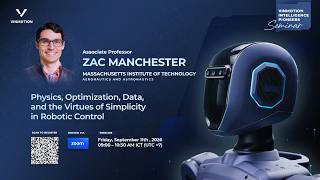
MIT associate professor Jack Manchester discusses how simple optimization, differentiable simulation, and compact control methods can support robotics across aquatic, terrestrial, and space applications, at a VinMotion seminar.
Seth Davis, senior program manager on Boston Dynamics’ Atlas team, describes Atlas’s World Cup halftime role and how the robot is being developed for factory work.
The Atlas Director of Robot Behavior at Boston Dynamics talks with NEXT host John Koetsier about Atlas’s design, robot intelligence, factory integration, and why legs can suit industrial work.