NVIDIA· Oct 23, 2026
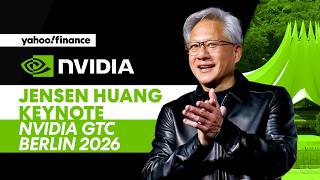
NVIDIA GTC Berlin 2026 Keynote With CEO Jensen Huang
NVIDIA founder and CEO Jensen Huang presents the company’s AI strategy and product announcements at GTC Berlin, with European partners and customers.
Les Carpus, global head of physical AI for NVIDIA’s Inception program, discusses robotics startups and the path to a ChatGPT moment with TechCrunch reporter Tim at Disrupt 2026.
Carpus groups vehicles, humanoids, factory robots, and smart buildings under physical AI because they all operate in real time amid unexpected conditions. He describes a data flywheel: use real-world deployment to improve simulation, then use simulation to refine and retrain models. When assessing startups, he prioritizes customer understanding, product-market fit, and teams that can integrate tools and deliver customer value independently.
Carpus says the right investment depends on where a robot fails: gather more real-world data for unfamiliar situations, generate synthetic data for known but difficult cases, or retrain when the data is good but the model is not learning. He expects companies to combine captured and synthetic data, with structured, metadata-rich collections supporting task-specific training. He also sees reusable, sim-ready 3D data as a valuable long-term resource.
Carpus expects focused robots to reach return on investment sooner, while general-purpose models could eventually perform many specific tasks. He describes world action models as tools for reasoning about scenes, transforming video conditions, and generating possible future sequences for training robot policies. He says current world models may lack physics understanding, though that limitation is being actively addressed.
Carpus expects broad returns from humanoids to take three to five years, citing regulatory and liability barriers, while wheeled bimanual robots may be easier to deploy. Legs can help in places such as construction sites with uneven ground, and human activity video offers potential training data for human-shaped robots. He defines a robotics ChatGPT moment as a robot learning a task in a new environment without an engineer guiding it, including recovering from mistakes.
Carpus points to larger context windows and parallel simulation as ways to improve robot learning and policy testing. He cautions startups against putting a third-party foundation model at the center of their value proposition, and says they should own their core model and post-training. He identifies multiphysics simulation, secure collaboration across different robot fleets, and fast feedback from field data as important challenges and opportunities.
Briefs summarise talks and interviews; timestamps open the video at that moment. Claims in a talk are the speaker's own.
NVIDIA founder and CEO Jensen Huang presents the company’s AI strategy and product announcements at GTC Berlin, with European partners and customers.
NVIDIA CEO Jensen Huang discusses Europe’s AI economy, NVIDIA’s AI infrastructure and agent platforms, and physical AI at GTC Berlin, with examples from European industry and NVIDIA partners.
The host and main speaker from Robotics Central explains Kawasaki’s staged plan to deploy Kaleido humanoid robots, and how Japan’s AI funding, Nvidia computing, and human remote operators fit into that effort.
Amulia Vishban, founder of Techable Ventures, discusses investing in physical AI with Dominic Madori Davis on TechCrunch’s Equity podcast.
Jensen Huang, NVIDIA’s CEO and founder, joins Lex Fridman in Taiwan during Computex to discuss the island’s engineering ecosystem, NVIDIA’s partnerships and AI infrastructure, and the value of cooperation amid competition.
Janette Buck of Stanford University, Kento Kawaharazuka of the University of Tokyo, Nikos Sagaris of the Human-Centered Mechatronics Lab, and Professor UK of UT Austin and NVIDIA discuss dexterous manipulation, humanoid design, modular robots, and foundation models at an IEEE Robotics and Automation Society keynote in Vienna.