NVIDIA· Oct 23, 2026
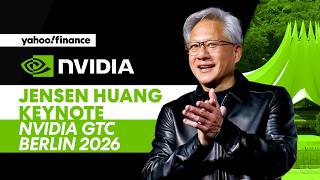
NVIDIA GTC Berlin 2026 Keynote With CEO Jensen Huang
NVIDIA founder and CEO Jensen Huang presents the company’s AI strategy and product announcements at GTC Berlin, with European partners and customers.
Amulia Vishban, founder of Techable Ventures, discusses investing in physical AI with Dominic Madori Davis on TechCrunch’s Equity podcast.
Vishban traces her path through signal processing, Intel, and NVIDIA, where she worked on AI software and robotics products. After years of helping build technical communities and launch products such as NVIDIA’s Isaac robotics platform, she started a firm to support companies from their earliest stages.
Vishban describes physical AI as bringing digital capabilities into tangible things, including materials, medicines, and robots. She sees opportunities in factory automation, where smaller businesses face labor shortages, and in surgical tools that could help specialists handle complex cases.
Vishban says automation can support existing work, such as helping clinicians or assisting older people, rather than being applied everywhere. She evaluates whether a use case can be financially viable and scaled, while pointing to changes in how researchers develop new ideas.
Asked whether robotics has had its ChatGPT breakthrough, Vishban says progress is underway but foundational work remains. She likens the current phase to assembling building blocks, citing actuators, simulation, safety practices, and standards as areas that need development before robotics can spread across applications.
Vishban wants founders to draw on her industry relationships and product experience for technical feedback, customer introductions, and pilot opportunities. She also sees talent, manufacturing capacity, and supply chains as challenges, while describing the US and China as contributors with different strengths in talent and production.
Briefs summarise talks and interviews; timestamps open the video at that moment. Claims in a talk are the speaker's own.
NVIDIA founder and CEO Jensen Huang presents the company’s AI strategy and product announcements at GTC Berlin, with European partners and customers.
NVIDIA CEO Jensen Huang discusses Europe’s AI economy, NVIDIA’s AI infrastructure and agent platforms, and physical AI at GTC Berlin, with examples from European industry and NVIDIA partners.
The host and main speaker from Robotics Central explains Kawasaki’s staged plan to deploy Kaleido humanoid robots, and how Japan’s AI funding, Nvidia computing, and human remote operators fit into that effort.
Les Carpus, global head of physical AI for NVIDIA’s Inception program, discusses robotics startups and the path to a ChatGPT moment with TechCrunch reporter Tim at Disrupt 2026.
Jensen Huang, NVIDIA’s CEO and founder, joins Lex Fridman in Taiwan during Computex to discuss the island’s engineering ecosystem, NVIDIA’s partnerships and AI infrastructure, and the value of cooperation amid competition.
Janette Buck of Stanford University, Kento Kawaharazuka of the University of Tokyo, Nikos Sagaris of the Human-Centered Mechatronics Lab, and Professor UK of UT Austin and NVIDIA discuss dexterous manipulation, humanoid design, modular robots, and foundation models at an IEEE Robotics and Automation Society keynote in Vienna.