NVIDIA· Oct 23, 2026
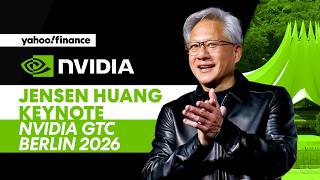
NVIDIA GTC Berlin 2026 Keynote With CEO Jensen Huang
NVIDIA founder and CEO Jensen Huang presents the company’s AI strategy and product announcements at GTC Berlin, with European partners and customers.
An NVIDIA Omniverse presenter at Physical AI Day at SIGGRAPH 2026 explains how world models, especially Cosmos, can help train and deploy AI in robots and other physical systems.
The presenter says AI has changed digital work, while factories, farms, vehicles and other physical systems remain a large opportunity. Teleoperation produces accurate demonstrations but is slow to scale, and simulations take work to build. World foundation models could generate robot-centered scenarios and turn computing time into training data.
The presenter describes Cosmos as a foundation for developers to build world models for their own needs. Cosmos 3 is presented as supporting text, images, video, audio and action, with an autoregressive tower for reasoning and a diffusion tower for generating outputs. The models are offered in three sizes: H at 4 billion parameters for on-device use, Nano at 16 billion as a starting point, and Super at 64 billion for higher-fidelity results.
Cosmos treats action as a core modality and represents movement with geometric elements such as body pose, end-effector pose and grasp state. The presenter says this lets vehicles, robot arms, humanoids and human-view videos map into a common scheme. The model can support dynamics, inverse dynamics and policy, connecting actions, observed outcomes and decisions.
The presenter frames dynamics as predicting effects, inverse dynamics as inferring actions from observed changes, and policy as selecting actions for a task. NVIDIA's Edge Policy demonstration runs on a Jetson Thor embedded device at about 130 watts, using camera input to control a robot arm in real time. Cosmos can also be adapted with a developer's own data, while distillation is described as cutting generation from 50 steps to four.
NVIDIA's Cosmos GitHub repository brings model releases, inference options, fine-tuning and distillation scripts together. The presenter says the platform includes open models, data and frameworks, and previews Cosmos 3.5 with multi-view modeling and a mixture-of-experts approach. A coalition of companies is expected to contribute research, data and evaluation.
Briefs summarise talks and interviews; timestamps open the video at that moment. Claims in a talk are the speaker's own.
NVIDIA founder and CEO Jensen Huang presents the company’s AI strategy and product announcements at GTC Berlin, with European partners and customers.
NVIDIA CEO Jensen Huang discusses Europe’s AI economy, NVIDIA’s AI infrastructure and agent platforms, and physical AI at GTC Berlin, with examples from European industry and NVIDIA partners.
The host and main speaker from Robotics Central explains Kawasaki’s staged plan to deploy Kaleido humanoid robots, and how Japan’s AI funding, Nvidia computing, and human remote operators fit into that effort.
Amulia Vishban, founder of Techable Ventures, discusses investing in physical AI with Dominic Madori Davis on TechCrunch’s Equity podcast.
Les Carpus, global head of physical AI for NVIDIA’s Inception program, discusses robotics startups and the path to a ChatGPT moment with TechCrunch reporter Tim at Disrupt 2026.
Jensen Huang, NVIDIA’s CEO and founder, joins Lex Fridman in Taiwan during Computex to discuss the island’s engineering ecosystem, NVIDIA’s partnerships and AI infrastructure, and the value of cooperation amid competition.