Jeremy Fishel, principal scientist and researcher at Sanctuary AI, discusses dexterous hands and tactile sensing with Jeff Rick at the Humanoids Summit in Mountain View, California.
Fishel says handling objects is harder than vision because it requires robots to deal with friction, force, mass, and energy transfer while interacting with the world. Packing many moving parts and durable touch sensors into a small hand makes both simulation and hardware challenging.
The hand’s skin, friction, and flexibility shape what it can sense, so touch cannot be reduced to a high-resolution map of force. Fishel values broad tactile coverage and fast-changing signals over fine spatial detail alone, and says robots need sensing across their bodies, not just at the fingertips.
Fishel describes manipulation as adapting to the world rather than forcing a fixed motion through it. Flexible outer surfaces can give a robot time to detect contact and respond; he argues that this could let robots move faster while reducing damage to themselves and people nearby.
Fishel says dexterity involves intelligent responses, coordinated fingers, and actions such as turning an object in the hand. He sees the main case for human-like hands as their controllability: people can operate systems with many degrees of freedom, making hands useful for teleoperation and learning human manipulation skills.
Fishel says Sanctuary is preparing a hydraulic next-generation hand designed to be more durable and cost-effective. The team plans to cover it with tactile sensing, but he gives no release date, saying an announcement will come when the system is ready to support its claims.
Briefs summarise talks and interviews; timestamps open the video at that moment. Claims in a talk are the speaker's own.
Geordie Rose, co-founder and CEO of Sanctuary AI, discusses humanoid robot autonomy, dexterous hands, and the economic and philosophical questions around automation with Jason on This Week in Startups.
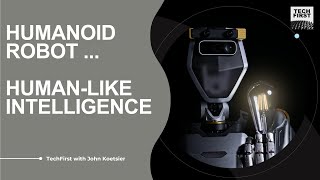
Geordie Rose, co-founder and CEO of Sanctuary AI, discusses the company’s Phoenix humanoid robot, its AI and hardware strategy, and its early commercial applications with John Koetsier on NEXT’s TechFirst.
Geordie Rose, CEO of Sanctuary AI and founder of D-Wave and Kindred AI, discusses language models, minds and consciousness, quantum computing, and building general-purpose humanoid robots with Alex Conconi.
Suzanne Gildert, CTO of Sanctuary AI, discusses the company’s humanoid robot and its path toward general-purpose work with a Bloomberg Originals host in Vancouver.