CGTN hosts and reporters discuss Unitree Robotics, Chinese robotics supply chains, commercial aerospace, drones, eVTOLs and autonomous driving with CGTN colleagues, joined by a Unitree G1 humanoid robot and robot dog.
A CGTN reporter describes visiting Unitree Robotics in Hangzhou and running alongside its humanoid robot. The G1 is described as costing about 10,000 yuan, with roughly 23 degrees of freedom in each arm; the discussion contrasts its mobility with its still-limited ability to understand instructions and manipulate objects. The panel also mentions Unitree’s Spring Festival Gala performance and Deep Robotics’ capable robot dogs.
The panel explains that reinforcement learning helps robots adjust their gait to conditions, while combining it with vision and large language models could expand what they can do. Speakers point to finger control and dexterity as difficult engineering challenges. Humanoid bodies may suit homes designed for people and companionship, while wheels, industrial arms and other forms can work better for specific tasks.
The discussion links affordable service robots to domestic sourcing, including components and chips, and cites China’s dense supplier networks. Speakers describe companies such as Unitree and Xiaomi assembling products from specialized suppliers, supported by nearby parts makers and many places to test designs. They say manufacturing scenarios in China let firms refine products through repeated production-line use.
The panel contrasts China’s state-led deep-space projects with commercial aerospace focused on practical services such as communications, Earth observation and disaster response. Geostationary satellites could relay data from low-orbit spacecraft and track ships or rail cargo; satellite connectivity could also serve remote regions where ground networks are costly. Speakers discuss private launch providers, reusable rockets and the broader business chain of building, launching and operating satellites.
The panel describes drone food delivery already operating in Shenzhen and Guangzhou at ordinary delivery prices, and discusses eVTOL aircraft as a possible way to shorten trips across the Greater Bay Area. These systems rely on shared capabilities such as batteries, sensing, motion control and connectivity. For autonomous driving, speakers compare sensor-rich approaches using LiDAR with camera-based systems that depend more on machine learning, and discuss adding DeepSeek or other chatbots to cars.
Briefs summarise talks and interviews; timestamps open the video at that moment. Claims in a talk are the speaker's own.
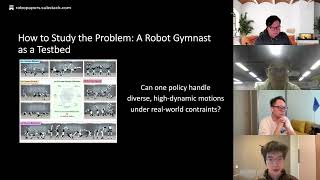
Yunshen Wang and Shaohang Zhu, paper authors from BIGAI and collaborating institutions including Unitree Robotics, discuss OmniXtreme’s approach to general high-dynamic humanoid control with RoboPapers hosts and audience.
Kalil 4.0 discusses humanoid robots for homes, factories, retail, and companionship, comparing emerging companies and their plans across the United States, China, Europe, and elsewhere.
PRO ROBOTS’ main presenter covers humanoid, service, industrial, and healthcare robots at China’s 2025 World Robot Conference, with demonstrations and interviews from exhibitors.
Sergey, host at Supercar Blondie, explores Unitree Robotics’ quadruped and humanoid robots at the company’s factory in China with Unitree representative Yolanda.
Tony Yang, sales manager at Unitree Robotics, introduces CEO and CTO Xingxing Wang’s G1 humanoid robot and discusses its design, cost, and intended uses.