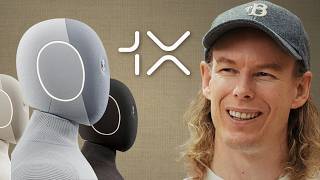
Jang says 1X’s compliant, tendon-driven hardware is designed for safe contact around people. Homes offer a wider range of tasks and environments than repetitive factory work, which he sees as valuable for training general intelligence.
Redwood is a language-controlled model that coordinates NEO’s legs, arms, hands, and neck for chores such as carrying laundry. Jang says cognitive prediction tasks, including estimating hand position and identifying objects, helped make the model compact. He describes the announced version as focused on whole-body task completion, with higher-level planning planned for later work.
Mobility and world models expand what robots can do
1X’s mobility update aims to make NEO useful beyond standing at a table: it can climb stairs, move sideways, and reach high or low. Jang says the controller combines natural motion tracking with steering by joystick or VR. The 1X world model generates video while responding to robot actions, and could help test policies across varied homes where hand-built simulations are impractical.
Jang sees supervised learning as compute-efficient and reinforcement learning as a complementary way to improve through interaction and feedback. Redwood trains on failed as well as successful rollouts to improve representations, though Jang says this is not yet a strict on-policy reinforcement learning update. Home deployments have also shown that reliability is essential for scaling product distribution.
Jang describes 1X’s broad strategy as deploying safe robots in homes, gathering diverse human and robot data, and using it to train systems that understand people and physical environments. He identifies open challenges in learning from failures, fitting capabilities onto limited onboard compute, and balancing safety, autonomy, and planning. He sees safe hardware and a focus on home chores as advantages for collecting useful data.
Briefs summarise talks and interviews; timestamps open the video at that moment. Claims in a talk are the speaker's own.
Eric Jang, AI team lead at 1X Technologies, describes the company’s humanoid robots and data engine at the Spring 2024 GRASP SFI event hosted by GRASP Lab.
Relentless host interviews Bernt Børnich, founder and CEO of 1X, about scaling humanoid robot manufacturing, learning from deployments, and building generally capable home robots.
Host and robotics analysts Scott Walter, Devang Adhyaru of the Humanoid Hub, Gustav, and Merdad examine 1X Technologies’ Neo hand and its mechanical design, demonstrations, and remaining uncertainties.
Dar Sleeper, vice president of design, product, and marketing at 1X, talks with Modern CTO host Joel Beasley about NEO, home robotics, and the path to shipping humanoids.
Melvin Tolliver IV, an integration technician at 1X, and colleagues at its Hayward factory describe assembling Neo, learning on the job, and the help they hope the robot will provide at home.