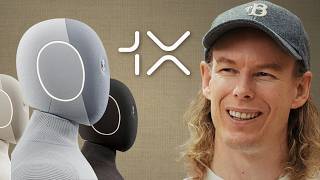
Sleeper says 1X is excited to begin shipping Neo by the end of the year, while emphasizing the many product and customer experience details involved. He attributes the robot’s target price of $20,000 partly to a simpler tendon-driven design, in-house manufacturing, and more than 10 years of motor innovation. He says those choices reduce parts and help lower bill of materials costs.
Sleeper describes Neo’s hands as having 22 actuated degrees of freedom, meaning each available degree can be actively controlled. He says closed-loop actuation also lets the hands rest in a natural shape. For Neo’s overall look, he favored soft materials, familiar forms, and reductive minimalism so the robot could fit into a home without demanding attention.
Sleeper says Neo can take on a friendly personality and blend into a home, where small chores such as picking up a sweatshirt, shoes, or a blanket may matter more than complex tasks like assembling furniture. He says people can adapt to having a humanoid robot in a few minutes. 1X is working on details such as making Neo’s suit removable and washable, while acknowledging that early owners may accept servicing or replacement cycles.
Sleeper says Neo’s capabilities can grow through software updates as 1X gathers data and improves its models. He compares the experience to frequent LLM upgrades and Tesla over-the-air updates, which can make early adopters feel rewarded and help introduce others to the product. He describes early users as an important source of feedback for iteration.
Sleeper says Neo is designed for general labor and could help anywhere people need support, including places facing labor shortages or aging populations. He argues that a home offers more varied data than a factory and can tolerate occasional errors, such as bringing ketchup instead of a beer, more readily than a production line. He sees home use as a practical starting point, while saying Neo is not limited to homes.
Briefs summarise talks and interviews; timestamps open the video at that moment. Claims in a talk are the speaker's own.
Dar Sleeper, vice president of design, product, and marketing at 1X, talks with Modern CTO host Joel Beasley about NEO, home robotics, and the path to shipping humanoids.
Relentless host interviews Bernt Børnich, founder and CEO of 1X, about scaling humanoid robot manufacturing, learning from deployments, and building generally capable home robots.
Host and robotics analysts Scott Walter, Devang Adhyaru of the Humanoid Hub, Gustav, and Merdad examine 1X Technologies’ Neo hand and its mechanical design, demonstrations, and remaining uncertainties.
Melvin Tolliver IV, an integration technician at 1X, and colleagues at its Hayward factory describe assembling Neo, learning on the job, and the help they hope the robot will provide at home.
Bloomberg Originals host and narrator, with 1X founder Bernt Børnich, UC Berkeley professor Ken Goldberg, GXO’s Patrick Kelleher, and other robotics, industry, and labor experts, examines humanoid robots’ potential and the hurdles they face in factories, warehouses, homes, and hospitals.