Chungchi says diverse action data is robotics’ main bottleneck: small datasets can lead researchers to results that fail in real homes. Sunday built its approach around a capture glove that lets people perform tasks directly, without first teleoperating a robot. The team says it had made nearly 100 glove iterations before designing Memo, using collected data to shape the robot’s hand and mechanics.
Chungchi describes manipulation as the first problem to solve, with mobility serving to position the hands. Memo’s wheeled base is designed to stay upright even if power is cut, and Sunday says its AI and data can carry over if the robot’s body changes later. The team focused on common chores such as unloading a dishwasher, while leaving tasks like retrieving items from a refrigerator for later.
Sunday says it had deployed its data collection system in 500 homes, gathering examples from places where people actually live. Chungchi says exposure to varied home layouts helps Memo generalize to unfamiliar homes, while the robot also uses three-dimensional environmental information. A dishwasher task involved dozens of distinct interactions, making each step’s reliability important to completing the full sequence.
Camila describes the Founding Family Program as a close collaboration with households willing to host and maintain Memo. Sunday may use teleoperation to explore tasks the robot has not yet learned, and the team hopes the glove can eventually let people teach Memo their preferred ways of doing chores. Feedback from many households could help Sunday decide which skills to train next.
Chungchi argues that robotics lacks the broad action datasets available for language models, making real-world data collection essential for progress. Sunday expects customers to buy Memo and pay separately for additional skills, with a target price below that of a car. Chungchi also calls for people across robotics disciplines to work together rather than treating one specialty as the only path forward.
Briefs summarise talks and interviews; timestamps open the video at that moment. Claims in a talk are the speaker's own.
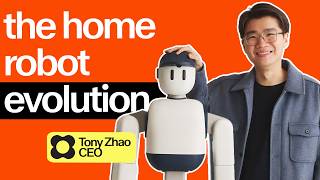
Claire Zau of ZAUEY visits Sunday Robotics with CEO Tony Zhao and head of product Camila to discuss Memo, a household robot that learns chores from human demonstrations.
Tony Xiao, founder of Sunday Robotics, explains to the Sources Podcast hosts how the company is developing Memo, a home robot trained with data from wearable gloves.
Rock of Over The Horizon talks with robotics designers Maharad Farmani and Scott Walter, and hand surgeon Gustav Anderson, about Sunday Robotics’ Mimo and its prospects for home and commercial work.
Sunday Robotics co-founders Tony Zhao and Cheng Chi join No Priors to discuss building Memo, a general-purpose home robot, and the data, hardware, and learning systems behind it.
Scott Walter, a robotics engineer and advisor, joins Over The Horizon hosts and guests to discuss Sharpa’s Dairy Queen deployment, Mimic’s dexterous hand, and Sunday Robotics’ home laundry results.