Automated Podcast· Sep 18, 2026
Tony Zhao on Training Home Robots With Human Data
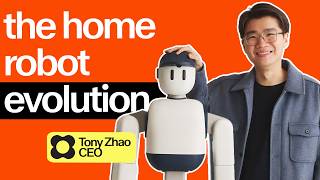
Tony Zhao, co-founder and CEO of Sunday Robotics, discusses training home robots with human-collected data with Brian Heater on Automated Podcast.
Sunday Robotics co-founders Tony Zhao and Cheng Chi join No Priors to discuss building Memo, a general-purpose home robot, and the data, hardware, and learning systems behind it.
Tony compares robotics to the period between GPT and GPT-2: researchers have promising methods, but have not yet scaled them enough for a strong consumer product. He says older robotics work often relied on task-specific sense-plan-act modules that had to be rebuilt for each environment, limiting reuse and slowing progress.
Tony explains that Diffusion Policy can learn multiple ways to act from paired observations and actions, making training more stable and allowing more people to collect demonstrations. Cheng says ALOHA made teleoperation feel more like a video game, while action chunking helped robots produce consistent movements. With UMI, people used a GoPro and a handheld gripper to collect 1,500 espresso-serving clips in about two weeks, including data outside a lab.
Cheng says Sunday grew from two founders working in Tony's apartment to a team of around 30 to 40 people, bringing mechanical, software, supply-chain, and controls expertise together. The company aims to reduce household chores and simplify the robot's design where possible, including using a three-fingered hand. Tony says perception lets the robot use lower-cost, compliant actuators and correct for mechanical imprecision.
Tony describes scaling as a difficult cycle involving hardware reliability, data collection, filtering, cleaning, and model training. Sunday has iterated through six glove versions, with about 20 revisions per version, and Cheng says more than 500 people use the gloves in the wild. They report nearly 10 million collected trajectories and say automatic calibration and fault detection help keep that data usable.
Cheng identifies training at scale and reliable hardware as major technical challenges, while Tony says Sunday built its data, operations, and training systems in-house. The founders plan a 2026 beta program, with a wider release potentially in 2027 or 2028; current prototypes cost $6,000 to $20,000, and they estimate scaled production could bring cost below $10,000. They describe demos involving dishwasher loading, transparent glassware, and sock folding, and advise judging robotics demos by what they actually show and how many interactions succeed.
Briefs summarise talks and interviews; timestamps open the video at that moment. Claims in a talk are the speaker's own.
Tony Zhao, co-founder and CEO of Sunday Robotics, discusses training home robots with human-collected data with Brian Heater on Automated Podcast.
Claire Zau of ZAUEY visits Sunday Robotics with CEO Tony Zhao and head of product Camila to discuss Memo, a household robot that learns chores from human demonstrations.
Tony Xiao, founder of Sunday Robotics, explains to the Sources Podcast hosts how the company is developing Memo, a home robot trained with data from wearable gloves.
Sunday Robotics cofounder Chungchi discusses collecting household robot training data with Scott and Mara on Marwa ElDiwiny’s show.
Rock of Over The Horizon talks with robotics designers Maharad Farmani and Scott Walter, and hand surgeon Gustav Anderson, about Sunday Robotics’ Mimo and its prospects for home and commercial work.
Scott Walter, a robotics engineer and advisor, joins Over The Horizon hosts and guests to discuss Sharpa’s Dairy Queen deployment, Mimic’s dexterous hand, and Sunday Robotics’ home laundry results.