@cobotulim4818· Mar 23, 2026
Interview at the NVIDIA GTC with Spencer Huang: Humanoid Robotics
Spencer Huang of Humanite Robotics discusses humanoid robotics, simulation, AI agents, and safety with a host at NVIDIA GTC.
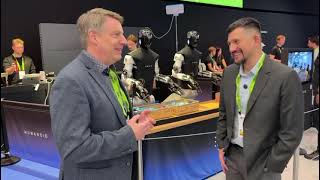
NVIDIA robotics product lead Spencer Huang discusses physical AI and robotics with The Humanoid Hub host at NVIDIA GTC in Washington, D.C.
Huang describes a progression from autonomous vehicles to humanoid robotics and says the required technologies are starting to take shape. Physical AI needs infrastructure that can simulate and test policies, then run them on real hardware before deployment. He says this hardware-in-the-loop process differs from the more homogeneous compute used for large language models.
Huang attributes recent progress in robot policies partly to greater access to compute and software optimized for it. He discusses flow matching for generating movement paths and DeepMimic, which uses human demonstrations to help train actions such as running, breakdancing, and parkour. For manipulation, he says imitation learning can be brittle while reinforcement learning can require extensive tuning, and combining them in simulation can improve robustness.
Huang says NVIDIA aims to open-source robotics platforms and models so teams can adapt them to varied domains, from manufacturing and warehousing to underwater, aerial, and space applications. He describes Cosmos and GR00T as base models that users can post-train for specific tasks, and says data quality and commercial licensing affect where each model can be used. A broader shared dataset could improve the generalist baseline, while valuable task-specific expertise still requires more data.
Huang groups robotics companies into those building hardware, brains, or both. Hardware teams need to settle on suitable robot morphology and sensors for their deployment setting, while brain-focused teams need a practical industry beachhead and compatible robot embodiments. He recommends choosing applications where basic skills can build into longer, more complex tasks and can be evaluated.
Huang sees assistance for older adults as an early home use, including carrying medicines, food, and blankets and responding to physical or emotional states. He also points to hospitals, where robots could take on some tasks and help overworked nurses focus on patient care. He says these uses do not require superhuman dexterity.
Briefs summarise talks and interviews; timestamps open the video at that moment. Claims in a talk are the speaker's own.
Spencer Huang of Humanite Robotics discusses humanoid robotics, simulation, AI agents, and safety with a host at NVIDIA GTC.
Spencer Wang, a robotics product manager at NVIDIA, discusses industrial robotics and automation with Helena Schwank of Hexagon.
NVIDIA founder and CEO Jensen Huang presents the company’s AI strategy and product announcements at GTC Berlin, with European partners and customers.
NVIDIA CEO Jensen Huang discusses Europe’s AI economy, NVIDIA’s AI infrastructure and agent platforms, and physical AI at GTC Berlin, with examples from European industry and NVIDIA partners.
The host and main speaker from Robotics Central explains Kawasaki’s staged plan to deploy Kaleido humanoid robots, and how Japan’s AI funding, Nvidia computing, and human remote operators fit into that effort.
Amulia Vishban, founder of Techable Ventures, discusses investing in physical AI with Dominic Madori Davis on TechCrunch’s Equity podcast.