The Humanoid Hub· Nov 1, 2025
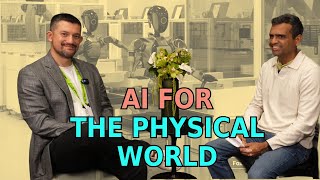
Spencer Huang Discusses NVIDIA's Physical AI Stack for Robotics
NVIDIA robotics product lead Spencer Huang discusses physical AI and robotics with The Humanoid Hub host at NVIDIA GTC in Washington, D.C.
Spencer Huang of Humanite Robotics discusses humanoid robotics, simulation, AI agents, and safety with a host at NVIDIA GTC.
Huang says humanoid autonomy is still developing, so teleoperation offers practical uses today. He points to remote data center checks, where an engineer could respond to an alert from home, and to perimeter security. Operating robots also helps teams improve their bodies and mechatronics while autonomy advances.
Huang expects computer vision in factories and smart buildings to grow before robots take on more complex physical interaction. He says simulation already works well for virtual commissioning of conventional robots, but dynamic control and contact with objects leave harder sim-to-real problems. The host notes that accurate physics, including modeling cloth, matters for closing those gaps.
Huang proposes using agents to generate and test simulation scenarios, vary objects, materials, and lighting, and search for edge cases in trained policies. He also describes automating data review: agents could identify unusual driving data, augment it, and help retrain models. He sees this as a way to run more experiments in the same amount of time.
Huang expects smarter household devices and mobile manipulators to appear within one to three years, with robots capable of real tasks developing over roughly five years. He argues that agentic systems and natural language could make robots easier to task and program, reducing reliance on specialist programming that can take months. He also says people should set the principles for functional safety, with AI helping test whether robots follow them.
Huang expects some retraining as AI spreads, but frames it as creating new roles and helping people do more. He compares AI-assisted radiology to expanded capacity for treating patients, rather than simply eliminating radiologist jobs. He says natural language could make learning new work easier, while agents help teams manage more tasks and accelerate robotics research.
Briefs summarise talks and interviews; timestamps open the video at that moment. Claims in a talk are the speaker's own.
NVIDIA robotics product lead Spencer Huang discusses physical AI and robotics with The Humanoid Hub host at NVIDIA GTC in Washington, D.C.
Spencer Wang, a robotics product manager at NVIDIA, discusses industrial robotics and automation with Helena Schwank of Hexagon.
NVIDIA founder and CEO Jensen Huang presents the company’s AI strategy and product announcements at GTC Berlin, with European partners and customers.
NVIDIA CEO Jensen Huang discusses Europe’s AI economy, NVIDIA’s AI infrastructure and agent platforms, and physical AI at GTC Berlin, with examples from European industry and NVIDIA partners.
The host and main speaker from Robotics Central explains Kawasaki’s staged plan to deploy Kaleido humanoid robots, and how Japan’s AI funding, Nvidia computing, and human remote operators fit into that effort.
Amulia Vishban, founder of Techable Ventures, discusses investing in physical AI with Dominic Madori Davis on TechCrunch’s Equity podcast.