Delivery robots offer a way to test last-mile automation, but frequent snags and falls show how difficult real-world robotics remains. Ames says legs can handle curbs, stairs, and uneven ground better than wheels, while wheels remain efficient on flat surfaces. Quadrupeds are being considered for building inspections and disaster response, though practical uses are still limited.
Humanoid dancing often starts with human motion capture, then uses reinforcement learning to reproduce the movements on a robot. Ames says this approach works when conditions match, but general-purpose autonomy in homes remains unsolved. He describes language models as useful for interpreting requests, while vision and robot control handle perception and movement; warehouse robots likewise move pallets well, while reliably picking varied items remains an open challenge.
Humanoid shapes can navigate spaces designed for people, but specialized machines often suit specific jobs better; warehouse robots, for example, move pallets efficiently. Ames contrasts cameras, which can identify objects, with LiDAR, which maps their positions across a wide field and helps avoid collisions. He argues that combining sensors can help in safety-critical settings.
Ames says autonomous driving safety has advanced through algorithms, software design, protocols, and evidence gathered from real deployments, while unusual road events remain difficult. Surgical robots contribute precise, repeatable motions, but surgeons provide tactile judgment when working with soft tissue. Clothes-folding robots face a related challenge because fabric is hard to model and manipulate.
Ames describes NEO as a home robot that relies on teleoperators for many tasks, with home use potentially generating training data. He doubts human demonstrations alone will provide enough varied motion data for general humanoid capability. In his view, robotics also needs models of physics, including forces and movement, because robot behavior is more than language.
Briefs summarise talks and interviews; timestamps open the video at that moment. Claims in a talk are the speaker's own.
Relentless host interviews Bernt Børnich, founder and CEO of 1X, about scaling humanoid robot manufacturing, learning from deployments, and building generally capable home robots.
Host and robotics analysts Scott Walter, Devang Adhyaru of the Humanoid Hub, Gustav, and Merdad examine 1X Technologies’ Neo hand and its mechanical design, demonstrations, and remaining uncertainties.
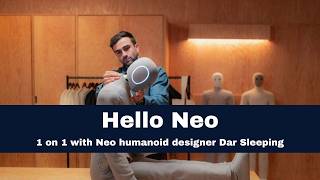
Dar Sleeper, vice president of design, product, and marketing at 1X, talks with Modern CTO host Joel Beasley about NEO, home robotics, and the path to shipping humanoids.
Melvin Tolliver IV, an integration technician at 1X, and colleagues at its Hayward factory describe assembling Neo, learning on the job, and the help they hope the robot will provide at home.
Bloomberg Originals host and narrator, with 1X founder Bernt Børnich, UC Berkeley professor Ken Goldberg, GXO’s Patrick Kelleher, and other robotics, industry, and labor experts, examines humanoid robots’ potential and the hurdles they face in factories, warehouses, homes, and hospitals.