Marc Raibert, founder of Boston Dynamics and executive director of the Boston Dynamics AI Institute, talks with Lex Fridman on the Lex Fridman Podcast about legged robotics, robot intelligence, and the work ahead.
Raibert traces his interest in legged robots to seeing a slow, tripod-stable walking robot and wanting to explore the opposite approach: bouncing, springy movement. His early pogo-stick robots used three control ideas: managing bounce energy, choosing where to place the foot, and keeping the body upright. He argues that manipulation also needs to move beyond cautious, static grasps toward more flexible ways of handling objects.
A $3,000 grant from Ivan Sutherland helped Raibert build his first hopping robot; a DARPA program manager later funded the work with $250,000. At Boston Dynamics, BigDog brought power, hydraulics, and computing onto one platform so it could be tested on trails, while the later Spot was designed to be smaller and less intimidating around people. Raibert says field testing revealed the importance of integrating hardware and controls, and of building robots that can take repeated testing and repair.
Raibert says natural movement depends on good hardware and controls that anticipate what will happen, rather than only correcting the robot's current position. The AI Institute aims to combine physical, or athletic, intelligence with cognitive abilities such as learning a task by watching a person. One project starts with bicycle repair, breaking observations into actions and mapping them to skills; Raibert says robots also need to handle situations with little explicit instruction.
Raibert describes four team qualities: technical fearlessness, diligence, intrepidness, and technical fun. Diligence means testing beyond the expected conditions, such as tugging on Spot while it opens a door. Atlas took 109 tries to climb a set of steps, and Raibert says the team recorded the attempts, improved the controls, and built in the capacity to repair the robot.
Raibert sees reliability, cost, and cognitive ability as major challenges for practical robots, and says Spot's reliability improved through sustained engineering work. He describes machine inspection as a path toward robots that can move from collecting thermal data, gauge readings, and sounds to diagnosing and fixing equipment. He also says that useful applications and the cost, safety, and performance balance remain key hurdles for robots in homes.
Briefs summarise talks and interviews; timestamps open the video at that moment. Claims in a talk are the speaker's own.
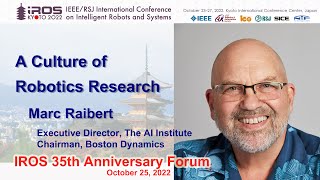
Marc Raibert, robotics researcher and founder of the AI Institute, discusses Boston Dynamics’ robots and the research culture he wants to build at the IROS 35th Anniversary Forum.
Boston Dynamics CEO Robert Playter talks with Lex Fridman about legged and humanoid robotics, the company’s path from research to commercial products, and how robots may work alongside people.
A Boston Dynamics Prototype Operations team member explains how the company builds and improves Atlas, from precision machining through assembly and testing, alongside its engineers.
Boston Dynamics’ robotics team discusses Atlas’s path to industrial work at Hyundai Motor Group’s Robotics Metaplant Application Center, with a host visiting the facility.
The Atlas Director of Robot Behavior at Boston Dynamics talks with NEXT host John Koetsier about Atlas’s design, robot intelligence, factory integration, and why legs can suit industrial work.