Humanoids Summit· Oct 19, 2026
Advanced Bionic Hands for Humans & Robots | Aadeel Akhtar (PSYONIC)
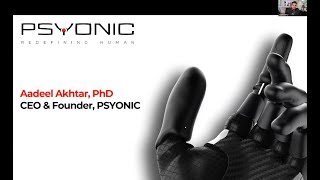
Aadeel Akhtar of PSYONIC presents at Humanoids Summit on bionic hands that serve prosthetic users and help robots learn manipulation tasks.
Aadeel Akhtar, founder and CEO of PSYONIC, discusses building bionic hands for people with limb differences and humanoid robots with Automated host Brian Heater.
Akhtar first wanted to become a doctor after meeting a girl in Pakistan who used a tree branch as a crutch. Studying computer science and seeing nerve-controlled prosthetics at Shirley Ryan AbilityLab led him to combine engineering with medicine. In Ecuador, a patient named Juan used an early Ability Hand to pinch after decades without that movement, convincing Akhtar to commercialize the technology.
Customer interviews revealed that users’ expensive prosthetic hands often broke after everyday bumps. PSYONIC responded with flexible fingers and a compliant four-bar linkage, while retaining 3D-printed parts inside the hand and reinforcing the palm with carbon fiber. Akhtar says the current hand costs $10,000 to $20,000, and higher production volumes could eventually bring the price below $5,000.
PSYONIC has open-sourced some earlier designs, though Akhtar says those versions give up some durability. In the United States, Medicare can cover the Ability Hand, leaving users responsible for a copay that may be zero or a few thousand dollars. The Ability Fund, created with the Range of Motion Project, uses each $25,000 donation to provide a hand and clinical care to one person and a leg to another in Guatemala or Ecuador.
Robotics researchers valued the hand’s control options and touch-sensor connections, and NASA later tested it on the Valkyrie humanoid. At NASA, PSYONIC user Anika used a lateral grasp to operate a zipper that engineers had struggled to move with a pinch grip. Akhtar says the same modular hand can be fitted to a human, Valkyrie, a Unitree humanoid, or a robot dog.
When Juan tried both a skin-matched hand and a black carbon-fiber version, he preferred the bionic look because it helped him feel confident and proud. Akhtar says a humanlike shape can also help transfer human experience to robots, while stronger motors could enable abilities beyond human grip strength. PSYONIC grew from seven employees to 45, and Akhtar describes media appearances and equity crowdfunding as ways to reach customers and let users invest.
Briefs summarise talks and interviews; timestamps open the video at that moment. Claims in a talk are the speaker's own.
Aadeel Akhtar of PSYONIC presents at Humanoids Summit on bionic hands that serve prosthetic users and help robots learn manipulation tasks.
Dr. Aadeel Akhtar, CEO and founder of Psyonic, explains how the company’s bionic hands serve both prosthetic users and robots at the Humanoids Summit.
Dr. Aadeel Akhtar, founder of PSYONIC, discusses building the Ability Hand for people with limb differences and robots with host Chris on Manufacturing Happy Hour.
Dr. Aadeel Akhtar, CEO and founder of Psyonic, discusses bionic hands for prosthetic users and robots with Jeff Rick at Humanoid Summit 2024.
Dr. Aadeel Akhtar, CEO and founder of PSYONIC, discusses affordable bionic hands, patient needs, and future prosthetics with the Next Big Thing Podcast hosts.
Aadeel Akhtar, CEO and founder of Psyonic, describes building affordable, accessible bionic limbs at the Institute for Neural Computation and answers questions from its audience.