Humanoids Summit· Oct 19, 2026
Advanced Bionic Hands for Humans & Robots | Aadeel Akhtar (PSYONIC)
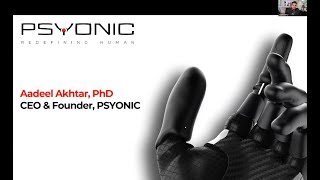
Aadeel Akhtar of PSYONIC presents at Humanoids Summit on bionic hands that serve prosthetic users and help robots learn manipulation tasks.
Dr. Aadeel Akhtar, CEO and founder of PSYONIC, discusses affordable bionic hands, patient needs, and future prosthetics with the Next Big Thing Podcast hosts.
Akhtar says meeting a child who had lost a leg while visiting Pakistan at age seven inspired him to build accessible bionic limbs. After studying biology, computer science, electrical engineering, and neuroscience, he developed a hand with a patient in Ecuador who made a pinch for the first time in 35 years. That experience led him to commercialize the technology through PSYONIC.
The current Ability Hand is the ninth generation, following years of rebuilding its hardware and software. Akhtar says soft silicone and rubber components help it withstand impacts, while the fingers close in about 200 milliseconds. Sensors in the fingers send touch information through vibration in the socket, helping users gauge pressure and release objects.
Akhtar says the hand was designed to meet patient needs for speed, durability, and touch feedback while fitting Medicare’s $31,000 coverage limit. PSYONIC set a $15,500 price point for the hand, and Akhtar says Medicare coverage expanded access beyond military and workplace injury cases. The same hand is also used in robotics research, including at NASA, and Akhtar describes a growing market for humanoid robots.
After a limited regional release in 2019, PSYONIC launched the Ability Hand nationwide in 2021. Akhtar reports revenue of about $200,000 in 2021 and more than $1 million in 2022, with profitability and demand exceeding production capacity. He says social media accounts for about half of sales, and StartEngine funding is going toward equipment and hiring to increase output.
Akhtar describes work with UC San Diego and Navy clinicians on osseointegration, which attaches a prosthesis to a titanium implant in the bone, and on nerve implants for individual finger control. He hopes these approaches could enable tasks such as typing or playing piano. Looking further ahead, he imagines nerve interfaces providing control and touch feedback for robotic devices and virtual reality.
Briefs summarise talks and interviews; timestamps open the video at that moment. Claims in a talk are the speaker's own.
Aadeel Akhtar of PSYONIC presents at Humanoids Summit on bionic hands that serve prosthetic users and help robots learn manipulation tasks.
Dr. Aadeel Akhtar, CEO and founder of Psyonic, explains how the company’s bionic hands serve both prosthetic users and robots at the Humanoids Summit.
Dr. Aadeel Akhtar, founder of PSYONIC, discusses building the Ability Hand for people with limb differences and robots with host Chris on Manufacturing Happy Hour.
Dr. Aadeel Akhtar, CEO and founder of Psyonic, discusses bionic hands for prosthetic users and robots with Jeff Rick at Humanoid Summit 2024.
Aadeel Akhtar, CEO and founder of Psyonic, describes building affordable, accessible bionic limbs at the Institute for Neural Computation and answers questions from its audience.
Adeel Actar, CEO of PSYONIC, describes how his team developed accessible bionic hands and how the technology is being used by prosthesis users and robotics companies.