NVIDIA· Oct 23, 2026
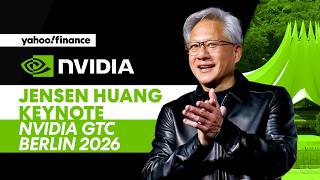
NVIDIA GTC Berlin 2026 Keynote With CEO Jensen Huang
NVIDIA founder and CEO Jensen Huang presents the company’s AI strategy and product announcements at GTC Berlin, with European partners and customers.
An NVIDIA Omniverse presenter at GTC San Jose 2026 explains how Cosmos world models can help physical AI developers create training data, simulate tasks, and improve robot policies.
The presenter frames physical AI as the next stage after generative and agent AI, and says robots lack the abundant training data available to internet models. Cosmos can learn from internet-scale data and help generate robot-focused examples, alongside physics engine data and real robot observations paired with actions.
The goal is a training environment where an agent practices tasks across varied settings before deployment. For example, a policy could learn to cut a cucumber in many kitchens; varying environments and tasks can help it generalize to unfamiliar situations. The system needs both a way to simulate what happens next and a way to judge whether the task succeeded.
The presenter describes Cosmos Reason for video understanding, Predict for forecasting future video, and Transfer for turning control signals into realistic scenes. A Cosmos Predict based policy achieved a reported 98.5% average success rate on Libero and performed strongly on RoboCasa. In real robot examples, it handled tasks such as folding a T-shirt with 15 demonstrations; model-based planning improved completion scores by an average of 12.5 points in challenging settings.
Cosmos Transfer can use depth, edges, segmentation, and other controls to generate realistic video, including multiple camera views. NVIDIA's AlphaDream driving simulator connects steering actions to changing visual scenes, and can run with the Alpamayo 1 driving policy. The presenter also previews Cosmos 3, which combines reasoning and generation and can take and produce inputs such as video, sound, text, and actions.
The presenter describes applications including surgical video generation, factory camera monitoring, and a physical data factory that combines physics simulation, generated variations, and video annotations. The central approach is to spend compute to create data that is difficult to collect in the physical world. Cosmos is intended to support physical agents by both interpreting their surroundings and modeling possible futures.
Briefs summarise talks and interviews; timestamps open the video at that moment. Claims in a talk are the speaker's own.
NVIDIA founder and CEO Jensen Huang presents the company’s AI strategy and product announcements at GTC Berlin, with European partners and customers.
NVIDIA CEO Jensen Huang discusses Europe’s AI economy, NVIDIA’s AI infrastructure and agent platforms, and physical AI at GTC Berlin, with examples from European industry and NVIDIA partners.
The host and main speaker from Robotics Central explains Kawasaki’s staged plan to deploy Kaleido humanoid robots, and how Japan’s AI funding, Nvidia computing, and human remote operators fit into that effort.
Amulia Vishban, founder of Techable Ventures, discusses investing in physical AI with Dominic Madori Davis on TechCrunch’s Equity podcast.
Les Carpus, global head of physical AI for NVIDIA’s Inception program, discusses robotics startups and the path to a ChatGPT moment with TechCrunch reporter Tim at Disrupt 2026.
Jensen Huang, NVIDIA’s CEO and founder, joins Lex Fridman in Taiwan during Computex to discuss the island’s engineering ecosystem, NVIDIA’s partnerships and AI infrastructure, and the value of cooperation amid competition.