NVIDIA· Oct 23, 2026
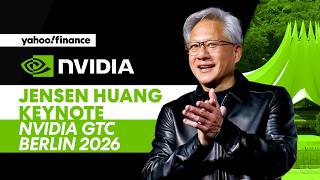
NVIDIA GTC Berlin 2026 Keynote With CEO Jensen Huang
NVIDIA founder and CEO Jensen Huang presents the company’s AI strategy and product announcements at GTC Berlin, with European partners and customers.
A NVIDIA Omniverse presenter at GTC explains how digital twins, simulation, and AI can help build and deploy physical AI systems.
The presenter frames physical AI as a way to bring computing into industries that work with physical goods and environments, including agriculture, transport, construction, life sciences, and manufacturing. Robots combine sensors, AI decisions, and physical actions in a continuous loop. The talk treats autonomous vehicles, instrumented buildings and cities, industrial robots, and healthcare robots as parts of this broader field.
Building a robot requires computers for training its AI, running that AI on the robot, and simulating the world around it. Simulation can supply training examples that are costly or risky to collect in reality, and help teams test systems before deployment. The presenter points to NVIDIA DGX for training and Jetson and IGX systems for running robotics software.
The presenter describes factories as coordinated systems of sensors, mobile robots, robotic arms, and humanoids. Teams can model factories before construction and use simulation to check layouts, commission equipment, and validate robot behavior. Examples named include PepsiCo, Krones, SK hynix, and warehouse projects involving GXO, Siemens, and other partners. AI factories also need simulations spanning equipment, heat, networks, power grids, and substations.
The Omniverse team is breaking its technology into libraries that can be used within other software and by coding agents. The presenter names OVRTX for rendering and USD, OV Physics, OV Storage, and SimReady tools for preparing assets for simulation. Agents could help teams build virtual environments, operate simulations, and assess results, reducing reliance on a small pool of simulation specialists. PTC integrations with Windchill and Onshape connect product design with simulation-ready assets.
The presenter describes Cosmos as a world model for understanding and predicting physical scenes, and outlines plans to combine prediction and understanding capabilities. Robotics teams can start with broad internet-scale information, then use simulated data to specialize and evaluate models in repeated training cycles. NVIDIA’s Physical AI Data Factory Blueprint supports generating, augmenting, and evaluating data; the presenter’s central claim is that more compute can help create training data without collecting every scenario in the real world.
Briefs summarise talks and interviews; timestamps open the video at that moment. Claims in a talk are the speaker's own.
NVIDIA founder and CEO Jensen Huang presents the company’s AI strategy and product announcements at GTC Berlin, with European partners and customers.
NVIDIA CEO Jensen Huang discusses Europe’s AI economy, NVIDIA’s AI infrastructure and agent platforms, and physical AI at GTC Berlin, with examples from European industry and NVIDIA partners.
The host and main speaker from Robotics Central explains Kawasaki’s staged plan to deploy Kaleido humanoid robots, and how Japan’s AI funding, Nvidia computing, and human remote operators fit into that effort.
Amulia Vishban, founder of Techable Ventures, discusses investing in physical AI with Dominic Madori Davis on TechCrunch’s Equity podcast.
Les Carpus, global head of physical AI for NVIDIA’s Inception program, discusses robotics startups and the path to a ChatGPT moment with TechCrunch reporter Tim at Disrupt 2026.
Jensen Huang, NVIDIA’s CEO and founder, joins Lex Fridman in Taiwan during Computex to discuss the island’s engineering ecosystem, NVIDIA’s partnerships and AI infrastructure, and the value of cooperation amid competition.