NVIDIA· Oct 23, 2026
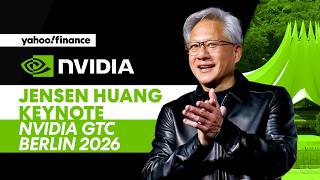
NVIDIA GTC Berlin 2026 Keynote With CEO Jensen Huang
NVIDIA founder and CEO Jensen Huang presents the company’s AI strategy and product announcements at GTC Berlin, with European partners and customers.
Mustafa Jay of NVIDIA hosts a GTC San Jose 2026 session on simulation-first development for healthcare robotics, with surgeon Filipo Fukori of Lenox Hill and Northwell Health, an autonomous surgery researcher from Johns Hopkins and CMR Surgical, Mustafa Jay, and Yossi of LEM Surgical.
Mustafa Jay frames healthcare as a high-demand field where physical AI could help, while emphasizing that data is the main challenge. He outlines a pipeline of curated real-world data, synthetic data and simulation to fill gaps, model training, and testing. He highlights generative physics, foundation models, and faster, higher-fidelity simulation as technologies that could support this work.
Filipo Fukori, a surgeon and robotic fellowship program director at Lenox Hill and Northwell Health, describes barriers to using surgical data, including medical-legal issues and the time required for clinician annotation. He says important events may occupy only 2% to 3% of a procedure video, and describes work on surgical gesture ontologies and using Cosmos tools to search and simulate surgical scenes. He also argues that simulation is underused in surgical training and describes efforts to create more realistic tool and tissue interactions.
An associate professor at Johns Hopkins who also identifies himself as chief robot officer at CMR Surgical describes a shift from model-based methods, which reached about 60% stitch-to-stitch success, toward imitation learning from demonstrations. His examples include tasks that achieved 100% success in reported trials, and an autonomous clipping and cutting phase tested on ex vivo porcine gallbladders using about 16 hours of data. He also discusses a surgical robotics dataset with more than 150,000 trajectories and early GR00T suturing results.
Mustafa Jay describes Maestro, a two-armed laparoscopic system, and a simulation workflow for optimizing arm deployment across different operating room setups. The team combines real video, Isaac Sim, and Cosmos Transfer to generate varied training imagery, while noting that the synthetic visuals still need improvement. Jay says the intended first step is a surgeon-triggered workspace optimization feature, with later work exploring vision-language-action models under safety controls.
Yossi, founder and CEO of LEM Surgical, contrasts hard-tissue robotics with soft-tissue systems and presents a three-arm architecture for orthopedic procedures. He says the robot must learn to work around surgical staff and many kinds of instruments, a problem he considers too complex for fixed decision matrices to scale. He sees simulation and synthetic data as ways to train the system before deployment in the operating room.
Briefs summarise talks and interviews; timestamps open the video at that moment. Claims in a talk are the speaker's own.
NVIDIA founder and CEO Jensen Huang presents the company’s AI strategy and product announcements at GTC Berlin, with European partners and customers.
NVIDIA CEO Jensen Huang discusses Europe’s AI economy, NVIDIA’s AI infrastructure and agent platforms, and physical AI at GTC Berlin, with examples from European industry and NVIDIA partners.
The host and main speaker from Robotics Central explains Kawasaki’s staged plan to deploy Kaleido humanoid robots, and how Japan’s AI funding, Nvidia computing, and human remote operators fit into that effort.
Amulia Vishban, founder of Techable Ventures, discusses investing in physical AI with Dominic Madori Davis on TechCrunch’s Equity podcast.
Les Carpus, global head of physical AI for NVIDIA’s Inception program, discusses robotics startups and the path to a ChatGPT moment with TechCrunch reporter Tim at Disrupt 2026.
Jensen Huang, NVIDIA’s CEO and founder, joins Lex Fridman in Taiwan during Computex to discuss the island’s engineering ecosystem, NVIDIA’s partnerships and AI infrastructure, and the value of cooperation amid competition.