NVIDIA· Oct 23, 2026
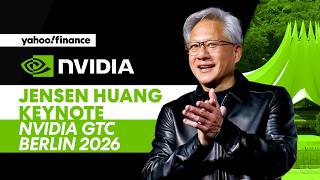
NVIDIA GTC Berlin 2026 Keynote With CEO Jensen Huang
NVIDIA founder and CEO Jensen Huang presents the company’s AI strategy and product announcements at GTC Berlin, with European partners and customers.
Mati Azizzian of NVIDIA, joined by Shawn Hoover and colleagues, presents at GTC San Jose 2026 on data-centric surgical robots, healthcare AI models, and hospital automation.
Mati Azizzian surveys surgical robots by access method, physical design, and autonomy level. Most commercial systems are teleoperated, and their proprietary connections make upgrades and interoperability difficult. He proposes a shared Ethernet backbone with distributed edge compute, where data can be accessed across system components.
Azizzian describes requirements including synchronized data, redundant paths for safety-critical signals, and secure access. In a sensor-to-action example, he contrasts about 50 milliseconds on current systems with a 1.2-millisecond input-to-output benchmark using a Holoscan Sensor Bridge and GPU pipeline. He also describes using the same robot compute across simulation and physical deployment.
Shawn Hoover says the Open Embodiment coalition grew to 35 partners and released a dataset covering eight robotic embodiments, including nearly 500 hours of clinical data donated by CMR Surgical. He shows a suturing model pretrained on that data and post-trained with a small amount of Johns Hopkins SutureBot data, while noting that many attempts failed. He also presents a world-model surgical simulator and a video tokenizer released for research.
Madi describes a hospital automation framework that links operating-room observations with software agents and mobile robots. In a demonstration, the system identifies upcoming instrument needs, checks whether items are available, and can send a robot to retrieve and prepare a tray from sterile processing. Madi says the demo still needs substantial productization.
The closing remarks envision data-centric, interoperable systems and discuss possible regulatory pathways for foundational models and software-defined medical devices. In response to a question about functional safety, a speaker says Sensor Bridge is configurable and open source, with watermarking and CRC checks under consideration for IEC 61508 certification; broader safety remains specific to each medical device.
Briefs summarise talks and interviews; timestamps open the video at that moment. Claims in a talk are the speaker's own.
NVIDIA founder and CEO Jensen Huang presents the company’s AI strategy and product announcements at GTC Berlin, with European partners and customers.
NVIDIA CEO Jensen Huang discusses Europe’s AI economy, NVIDIA’s AI infrastructure and agent platforms, and physical AI at GTC Berlin, with examples from European industry and NVIDIA partners.
The host and main speaker from Robotics Central explains Kawasaki’s staged plan to deploy Kaleido humanoid robots, and how Japan’s AI funding, Nvidia computing, and human remote operators fit into that effort.
Amulia Vishban, founder of Techable Ventures, discusses investing in physical AI with Dominic Madori Davis on TechCrunch’s Equity podcast.
Les Carpus, global head of physical AI for NVIDIA’s Inception program, discusses robotics startups and the path to a ChatGPT moment with TechCrunch reporter Tim at Disrupt 2026.
Jensen Huang, NVIDIA’s CEO and founder, joins Lex Fridman in Taiwan during Computex to discuss the island’s engineering ecosystem, NVIDIA’s partnerships and AI infrastructure, and the value of cooperation amid competition.