Choi Yon-sue, CFO of Holiday Robotics, discusses Korea’s role in the global AI robotics race with host and science communicator Kang Sung-joo on Arirang TV.
Kang Sung-joo calls NEO’s $499 monthly rental price a major shift, comparing it with the cost of household help. He describes early home deployments as a way for customers to influence the technology, while noting that many robots still rely on remote operators who control them through VR and help companies gather real-world data.
Kang contrasts China’s progress in robot movement, citing Unitree, with U.S. work on AI systems that interpret complex environments. Choi says robotics faces a shortage of training data for large models. Holiday Robotics splits planning from smaller, reusable physical skills to reduce the data needed for training.
Choi links Korea’s robotics strengths to precision manufacturing built around automotive, batteries, and shipbuilding. He clarifies that robot density measures factory robots per 10,000 human workers, not robots in public spaces. He sees potential for AI robots in high-value assembly industries such as cars, semiconductors, and batteries, as well as service work in restaurants, hospitality, clinics, and small businesses.
Choi says a 28-person team built the humanoid Friday in under a year after seed funding, drawing on specialists across robotics and AI. Each hand has 20 degrees of freedom and tactile sensors, enabling tasks such as handling objects and using tools. The company aims to combine AI planning with modular skills so robots can handle longer, less predictable factory jobs without teleoperators.
Choi says the names Friday, Saturday, and Sunday reflect Holiday Robotics’ aim to reduce repetitive and physically demanding work across factories, services, and homes. He argues that Korea’s next step is pairing its manufacturing strength with software and AI, and that deploying Friday in factories could demonstrate that combination.
Briefs summarise talks and interviews; timestamps open the video at that moment. Claims in a talk are the speaker's own.
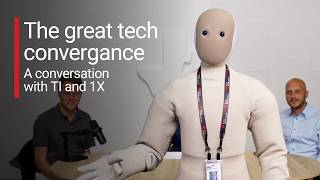
Mark Ying, director of automotive systems at Texas Instruments, discusses how automotive technology carries over to humanoid robotics with TI’s Giovanni and Tom Snavely, VP of engineering at 1X Technologies.
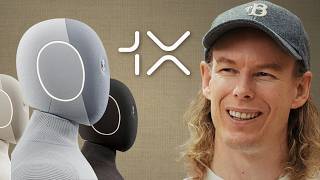
Relentless host interviews Bernt Børnich, founder and CEO of 1X, about scaling humanoid robot manufacturing, learning from deployments, and building generally capable home robots.
Host and robotics analysts Scott Walter, Devang Adhyaru of the Humanoid Hub, Gustav, and Merdad examine 1X Technologies’ Neo hand and its mechanical design, demonstrations, and remaining uncertainties.
Dar Sleeper, vice president of design, product, and marketing at 1X, talks with Modern CTO host Joel Beasley about NEO, home robotics, and the path to shipping humanoids.
Melvin Tolliver IV, an integration technician at 1X, and colleagues at its Hayward factory describe assembling Neo, learning on the job, and the help they hope the robot will provide at home.