NVIDIA· Oct 23, 2026
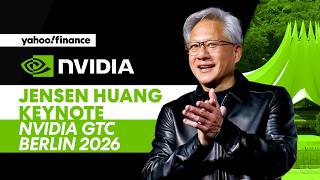
NVIDIA GTC Berlin 2026 Keynote With CEO Jensen Huang
NVIDIA founder and CEO Jensen Huang presents the company’s AI strategy and product announcements at GTC Berlin, with European partners and customers.
At the CoRL 2024 industry panel, robotics leaders from Google DeepMind, Toyota Research Institute, NVIDIA, and Physical Intelligence discuss research priorities, routes to deployment, and the future of robotics.
Nicholas Heess described Google DeepMind’s work on dexterity and robotic foundation models, with questions around data, generalization, autonomous learning, and simulation. Russ Tedrake outlined Toyota Research Institute’s shift toward large behavior models and its Boston Dynamics partnership. NVIDIA’s Yashash presented its compute and software platforms, including Isaac Lab and GR00T, while Physical Intelligence’s Sage described its π₀ vision-language-action model trained on data from multiple robots.
Panelists pointed to more capable robot movements, early signs of behavioral generalization, and ways to bring world knowledge from foundation models into robotics. They also cited lower-cost hardware, improved simulation, real-to-sim methods, and video or latent dynamics models. The optimism came with a caveat: these pieces are still incomplete and need more work together.
Panelists said research takes time and capital, while public trust can suffer when demos are hard to verify. They called for reproducible demonstrations and clearer reporting of conditions, success rates, and evaluation results. Nicholas Heess noted that evaluating many tasks is costly, making better evaluation methods a community need.
Physical Intelligence said its first π₀ release used real-world data and evaluations, including hundreds of hours of robot operation, and described simulation as useful for faster feedback but challenging for diverse dexterous tasks. NVIDIA’s Yashash said both homes and industry pose difficult problems: homes are unstructured, while industrial settings demand precision, reliability, and fast cycle times. Panelists identified logistics and truck unloading as areas where learning could yield near-term returns, while cautioning against narrowing general-purpose research too early.
Panelists called autonomous driving a technological success and highlighted lessons in real-world data collection, curation, labeling, and evaluation, while noting commercial success remains to be seen. They contrasted driving’s rare-event safety challenges with the variety of tasks and requirements facing general-purpose robots. The panel ended on a broadly optimistic note, alongside concern that hype could trigger backlash and undermine real progress.
Briefs summarise talks and interviews; timestamps open the video at that moment. Claims in a talk are the speaker's own.
NVIDIA founder and CEO Jensen Huang presents the company’s AI strategy and product announcements at GTC Berlin, with European partners and customers.
NVIDIA CEO Jensen Huang discusses Europe’s AI economy, NVIDIA’s AI infrastructure and agent platforms, and physical AI at GTC Berlin, with examples from European industry and NVIDIA partners.
The host and main speaker from Robotics Central explains Kawasaki’s staged plan to deploy Kaleido humanoid robots, and how Japan’s AI funding, Nvidia computing, and human remote operators fit into that effort.
Amulia Vishban, founder of Techable Ventures, discusses investing in physical AI with Dominic Madori Davis on TechCrunch’s Equity podcast.
Les Carpus, global head of physical AI for NVIDIA’s Inception program, discusses robotics startups and the path to a ChatGPT moment with TechCrunch reporter Tim at Disrupt 2026.
Jensen Huang, NVIDIA’s CEO and founder, joins Lex Fridman in Taiwan during Computex to discuss the island’s engineering ecosystem, NVIDIA’s partnerships and AI infrastructure, and the value of cooperation amid competition.