NVIDIA· Oct 23, 2026
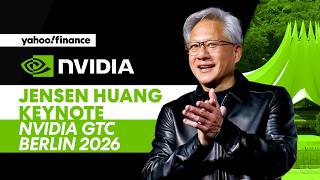
NVIDIA GTC Berlin 2026 Keynote With CEO Jensen Huang
NVIDIA founder and CEO Jensen Huang presents the company’s AI strategy and product announcements at GTC Berlin, with European partners and customers.
A NVIDIA presenter explains how simulation and foundation models can expand training data for autonomous vehicles and robots, citing work by developers and companies including Periton AI, Skild AI, and Disney Research.
NVIDIA Alpamayo enables vehicles to explain actions such as changing lanes and steering around a car blocking their path. The presenter also demonstrates following a spoken request to accelerate.
Robots must handle varied, unpredictable conditions and rare edge cases, which real-world examples alone cannot cover. The presenter argues that simulated data is essential for training physical AI.
Developers pre-train world models on large collections of video and human demonstrations, then assess them before further training. NVIDIA's tools include Isaac Lab for simulated training and assessment, Newton for GPU-based physics simulation, Cosmos for model-generated simulation, and GR00T for robot reasoning and action generation.
Periton AI combines Isaac Lab and Cosmos to expand training data for an operating room assistant. Skild AI generates additional training data and uses reinforcement learning across many variations; Humanoid and Hexagon Robotics also train policies with Isaac Lab. Foxconn and Noble Machines fine-tune GR00T models, while Disney Research uses Newton and Isaac Lab with its Camino simulator to train character robots.
Briefs summarise talks and interviews; timestamps open the video at that moment. Claims in a talk are the speaker's own.
NVIDIA founder and CEO Jensen Huang presents the company’s AI strategy and product announcements at GTC Berlin, with European partners and customers.
NVIDIA CEO Jensen Huang discusses Europe’s AI economy, NVIDIA’s AI infrastructure and agent platforms, and physical AI at GTC Berlin, with examples from European industry and NVIDIA partners.
The host and main speaker from Robotics Central explains Kawasaki’s staged plan to deploy Kaleido humanoid robots, and how Japan’s AI funding, Nvidia computing, and human remote operators fit into that effort.
Amulia Vishban, founder of Techable Ventures, discusses investing in physical AI with Dominic Madori Davis on TechCrunch’s Equity podcast.
Les Carpus, global head of physical AI for NVIDIA’s Inception program, discusses robotics startups and the path to a ChatGPT moment with TechCrunch reporter Tim at Disrupt 2026.
Jensen Huang, NVIDIA’s CEO and founder, joins Lex Fridman in Taiwan during Computex to discuss the island’s engineering ecosystem, NVIDIA’s partnerships and AI infrastructure, and the value of cooperation amid competition.