NVIDIA· Oct 23, 2026
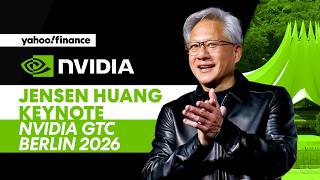
NVIDIA GTC Berlin 2026 Keynote With CEO Jensen Huang
NVIDIA founder and CEO Jensen Huang presents the company’s AI strategy and product announcements at GTC Berlin, with European partners and customers.
Arnaud Rubattel, president of Hexagon Robotics, leads a panel with Rev Lebaredian of NVIDIA, Ulrich Homann of Microsoft, and Michael Nikolaides of BMW on moving humanoid robots and physical AI into production.
Lebaredian says agentic AI could speed up digital-twin creation, a major bottleneck in building simulations for physical AI. Homann describes AI capabilities moving from cloud systems into factories and robots. Nikolaides says BMW uses a digital twin of its global production for virtual planning and reports that humanoids helped build 30,000 X3s at Spartanburg.
Panelists expect more applications, faster learning, and production systems that can adjust plans when conditions change. Homann points to robotics foundation models that combine vision, 3D understanding, and actuator data. Lebaredian argues that realistic simulation can give robots safe practice across rare scenarios, and that AI coding agents could automate building simulated environments; Nikolaides stresses that companies first need clean, consistent, accessible production data.
Nikolaides says robots must work reliably through full shifts and become economically viable for wider industrial use. Homann highlights shared standards for robot identity, monitoring, security, and fleet management, alongside software practices such as CI/CD and controlled updates. Lebaredian identifies manufacturing robots at scale as a key challenge for reducing costs and building durable systems.
BMW has tested a humanoid loading sheet metal into a machine and is piloting battery assembly work at Leipzig, with logistics as another possible application area. On safety, Lebaredian calls for protections across the full technology stack, open standards, and simulation-based testing before deployment. Homann adds that safe operation must include maintenance and software updates, while Nikolaides says early industrial safety results have been encouraging.
Nikolaides says workers in Spartanburg and Leipzig showed curiosity and enthusiasm about working alongside humanoids, provided safety is addressed. Lebaredian expects more natural collaboration as robots become safer and better able to adapt to people. Homann calls for broader discussion about which work belongs to people, where robots can help, and how the two can work together.
Briefs summarise talks and interviews; timestamps open the video at that moment. Claims in a talk are the speaker's own.
NVIDIA founder and CEO Jensen Huang presents the company’s AI strategy and product announcements at GTC Berlin, with European partners and customers.
NVIDIA CEO Jensen Huang discusses Europe’s AI economy, NVIDIA’s AI infrastructure and agent platforms, and physical AI at GTC Berlin, with examples from European industry and NVIDIA partners.
The host and main speaker from Robotics Central explains Kawasaki’s staged plan to deploy Kaleido humanoid robots, and how Japan’s AI funding, Nvidia computing, and human remote operators fit into that effort.
Amulia Vishban, founder of Techable Ventures, discusses investing in physical AI with Dominic Madori Davis on TechCrunch’s Equity podcast.
Les Carpus, global head of physical AI for NVIDIA’s Inception program, discusses robotics startups and the path to a ChatGPT moment with TechCrunch reporter Tim at Disrupt 2026.
Jensen Huang, NVIDIA’s CEO and founder, joins Lex Fridman in Taiwan during Computex to discuss the island’s engineering ecosystem, NVIDIA’s partnerships and AI infrastructure, and the value of cooperation amid competition.