NVIDIA· Oct 23, 2026
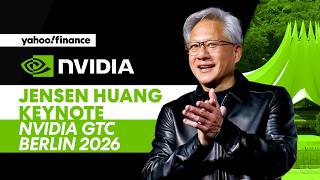
NVIDIA GTC Berlin 2026 Keynote With CEO Jensen Huang
NVIDIA founder and CEO Jensen Huang presents the company’s AI strategy and product announcements at GTC Berlin, with European partners and customers.
Aaron Luke, NVIDIA’s OpenUSD standards lead and chair of AOUSD’s Core Specification Working Group, explains how OpenUSD standards and SimReady can support physical AI simulation at a GTC session; audience members from Eaton and Biotech join the Q&A.
Luke traces USD’s development from Pixar’s Presto animation system and describes its spread into robotics, industrial digitalization, and autonomous vehicles. He highlights three capabilities: composing data from different sources, extending the model with domain schemas, and using storage methods beyond files.
Luke outlines a path from community proposals to tested implementations, adoption, and formal AOUSD specifications. He describes a standards structure that starts with the domain-neutral core, adds specifications for areas such as geometry and physics, then provides guidance for particular industries. He says adoption should build before a specification is standardized.
Luke argues that simulation needs more digitally created training scenarios because real-world data capture is limited. NVIDIA’s SimReady work aims to make simulation assets accurate, modular, and consistent across solvers. The announced SimReady SDK is intended to provide specifications, validation guidance, and reference pipelines and runtimes.
Luke cites FANUC robot assets, Lightwheel’s physics measurements, Cadence’s thermal specification work, and PTC’s factory and PLM contributions. He points listeners to guides, samples, learning resources, certification, and AOUSD participation as ways to contribute. He emphasizes defining the underlying problem before choosing a technical solution.
In the Q&A, Luke says Functional Mock-up Interface (FMI) could connect Functional Mock-up Units with USD, allowing assets to include behavior implementations from different solvers; he notes that its roadmap placement is undecided. On large-scene collaboration, he compares factory planning roles with departments in film production and says teams can lose time by addressing the wrong problem.
Briefs summarise talks and interviews; timestamps open the video at that moment. Claims in a talk are the speaker's own.
NVIDIA founder and CEO Jensen Huang presents the company’s AI strategy and product announcements at GTC Berlin, with European partners and customers.
NVIDIA CEO Jensen Huang discusses Europe’s AI economy, NVIDIA’s AI infrastructure and agent platforms, and physical AI at GTC Berlin, with examples from European industry and NVIDIA partners.
The host and main speaker from Robotics Central explains Kawasaki’s staged plan to deploy Kaleido humanoid robots, and how Japan’s AI funding, Nvidia computing, and human remote operators fit into that effort.
Amulia Vishban, founder of Techable Ventures, discusses investing in physical AI with Dominic Madori Davis on TechCrunch’s Equity podcast.
Les Carpus, global head of physical AI for NVIDIA’s Inception program, discusses robotics startups and the path to a ChatGPT moment with TechCrunch reporter Tim at Disrupt 2026.
Jensen Huang, NVIDIA’s CEO and founder, joins Lex Fridman in Taiwan during Computex to discuss the island’s engineering ecosystem, NVIDIA’s partnerships and AI infrastructure, and the value of cooperation amid competition.