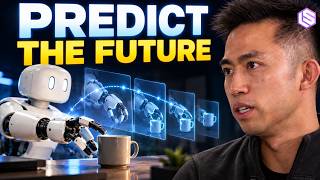
Ma says Dyna Robotics combines in-house research with commercial deployments so real customer work can guide research and produce production-quality data. The company trains general-purpose manipulation models from teleoperation data, aiming to address the gap between flashy demonstrations and dependable real-world performance.
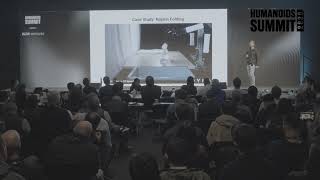
A robot brought from Dyna’s Redwood City office folds T-shirts at SFJAZZ without on-site data collection, despite encountering the venue and audience for the first time. Ma also shows tool use, cup stacking, multi-step meal preparation, and candy picking based on changing spoken requests. He says each demonstrated task used fewer than 10 hours of data and shared the same model architecture.
Ma describes Dyna’s napkin-folding result: more than 850 napkins folded in a continuous 24-hour run at a 99.4% success rate, repeated about four times in one week. He says a standard training approach reached roughly 80%, while a reward model that scores task progress helped identify good and bad trajectories so the robot could learn from its own runs. The model also recovered from errors such as grasping a stack of napkins instead of one.
Ma shows the napkin-folding model operating at a restaurant in Los Angeles. He identifies three ongoing challenges: comparing very high-performing models without hundreds of live trials, making useful use of lower-quality human video, and enabling improvement from a small number of trajectories collected at customer sites.
Briefs summarise talks and interviews; timestamps open the video at that moment. Claims in a talk are the speaker's own.
Jason Ma, Dyna Robotics co-founder and chief scientist, joins Latent Space on site to discuss Dyna-2, robot learning, hardware, and commercial deployments.
Jason Ma, co-founder and AI research lead at Dyna Robotics, presents Dyna 2’s approach to robot learning and commercial deployment at the Fellows Forum on Day 2.
Jason Ma, a robotics researcher at the University of Pennsylvania who worked on the paper at Google DeepMind, joins RoboPapers hosts Michael and Chris to discuss using vision-language models to assess robot task progress and data quality.
Jensen Huang, CEO of Nvidia, describes how AI is being used inside the company and predicts that robotics will reshape factories; AI Explained host discusses these claims with robotics researcher Jason Ma and IPPR report author Carsten Young.
Jason Ma, researcher at the University of Pennsylvania, presents research on safer and reward-free offline reinforcement learning at a GRASP Lab seminar.