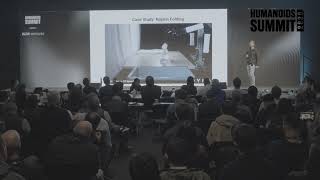
Jason Ma, co-founder and AI research lead at Dyna Robotics, presents Dyna 2’s approach to robot learning and commercial deployment at the Fellows Forum on Day 2.
Ma says Dyna builds and deploys robots for tasks at hotels, restaurants, laundromats, and gyms. He describes research, hardware, and customer use as a cycle: field needs guide what the company develops, while new models and robots help address harder tasks. Earlier Dyna systems folded napkins for long stretches and worked in an unfamiliar conference setting without additional training.
Ma says Dyna 2 uses a world-action architecture that predicts both actions and how the scene will change. It was pretrained on roughly a million hours of first-person human footage, then adapted with relatively little robot data. In tests on robot tasks absent from pretraining, adding more human data improved action predictions, which Ma presents as evidence of transfer from human activity to robots.
After a small amount of fine-tuning, the model can handle tasks with different robot forms, including dexterous hands. Ma reports that the human-like hand needed less task data to exceed 80% success than a simpler gripper, suggesting that similarity to the training data can matter more than mechanical simplicity. He also highlights performance in unusual lighting, delicate cookie handling, and language-guided workflows.
Ma points to Dyna robots folding napkins at more than 10 Din Tai Fung locations and working at Best Western, with customers seeking broader rollouts. He says deployment depends on the whole system, including task quality, language controls, and monitoring that records robot behavior throughout the day. For deployed tasks, Dyna aims for over 99% success before sending a robot to a site.
Ma says million-hour training requires data systems that ingest and serve large datasets efficiently, alongside caching and multi-cloud support. Dyna focuses on keeping training and launch speeds steady as datasets grow, so researchers can run repeated experiments. He summarizes the company’s approach as combining research, hardware, deployment, and infrastructure.
Briefs summarise talks and interviews; timestamps open the video at that moment. Claims in a talk are the speaker's own.
Jason Ma, Dyna Robotics co-founder and chief scientist, joins Latent Space on site to discuss Dyna-2, robot learning, hardware, and commercial deployments.
Jason Ma, a robotics researcher at the University of Pennsylvania who worked on the paper at Google DeepMind, joins RoboPapers hosts Michael and Chris to discuss using vision-language models to assess robot task progress and data quality.
Jensen Huang, CEO of Nvidia, describes how AI is being used inside the company and predicts that robotics will reshape factories; AI Explained host discusses these claims with robotics researcher Jason Ma and IPPR report author Carsten Young.
Jason Ma, researcher at the University of Pennsylvania, presents research on safer and reward-free offline reinforcement learning at a GRASP Lab seminar.