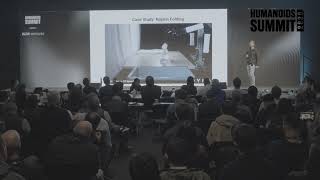
Jason Ma, Dyna Robotics co-founder and chief scientist, joins Latent Space on site to discuss Dyna-2, robot learning, hardware, and commercial deployments.
Ma describes a model that uses recent camera footage, joint measurements, and spoken instructions to forecast what the robot will see next and produce movements it can carry out. Dyna-2 combines those predictions with actions, using a diffusion transformer and flow matching to generate smooth, precise motion. He says the system was pretrained with roughly a million hours of human activity data.
Dyna starts with broad human activity data, then adapts the model to specific tasks with robot demonstrations, which Ma says can take from tens of minutes to a few hours. Human footage helps the model learn varied physical interactions, while robot data addresses differences between human movement and the company’s hardware. Ma also sees value in task-specific collections and synthetic environments generated with newer vision models.
Because physical tasks require quick reactions, Ma says deployed models need to run locally, even if larger models are used during training and then distilled. Dyna builds its own inference stack and develops components such as actuators, while buying established parts like LiDAR. Its wheeled semi-humanoid design includes a movable torso to better match how people reach and handle objects.
The team collects demonstrations, runs the robot on the real setup, and adds data when performance falls short. Ma says Dyna robots fold thousands of napkins each day across Din Tai Fung locations, and the customer is considering additional tasks. He identifies data and hardware reliability as major constraints, while describing a long laundry workflow that can take about an hour.
Ma argues that robotics progress depends on scaling suitable data, but sensor choices shape what a robot can learn; he points to touch and sound as potentially important additions to vision. Dyna’s approach predicts changes in the surrounding world as well as robot movement, with a higher-level agent coordinating steps across longer jobs. The company’s goal is to expand deployments from dozens of robots toward hundreds next year.
Briefs summarise talks and interviews; timestamps open the video at that moment. Claims in a talk are the speaker's own.
Jason Ma, co-founder and AI research lead at Dyna Robotics, presents Dyna 2’s approach to robot learning and commercial deployment at the Fellows Forum on Day 2.
Jason Ma, a robotics researcher at the University of Pennsylvania who worked on the paper at Google DeepMind, joins RoboPapers hosts Michael and Chris to discuss using vision-language models to assess robot task progress and data quality.
Jensen Huang, CEO of Nvidia, describes how AI is being used inside the company and predicts that robotics will reshape factories; AI Explained host discusses these claims with robotics researcher Jason Ma and IPPR report author Carsten Young.
Jason Ma, researcher at the University of Pennsylvania, presents research on safer and reward-free offline reinforcement learning at a GRASP Lab seminar.