John Koetsier of NEXT speaks with Alexandra Sukharev, a vice president at Bessemer Venture Partners, about which companies may succeed in humanoid robotics and the challenges of real world deployment.
Sukharev points to Boston Dynamics’ Atlas demo, 1X’s home chores demonstrations, and Physical Intelligence’s bimanual tasks as signs of rapid progress. She says the companies to watch are those that can move beyond impressive demonstrations to reliable operation, since mistakes in physical settings can damage property or injure people.
Sukharev says some companies are targeting narrow tasks or industrial settings first, where they can build reliability before attempting home use. She highlights repetitive, physically difficult work such as heavy lifting, and notes that many applications may be better served by non-humanoid robots. Warehouses, manufacturing, and hospitals do not always require a bipedal robot or dexterous hands.
Koetsier describes a 1X hand with 22 actuated degrees of freedom and emphasizes its speed and more natural resting position. He and Sukharev discuss how slow operation, noise, and limited dexterity can undermine practical value, especially at home or in hospitals. Koetsier says tasks that take a robot many times longer than a person may not justify the cost.
Sukharev says robotics lacks the internet-scale training data available for language models, and video or teleoperated demonstrations do not fully solve the gap between training and real-world performance. Approaches include collecting task data with different grippers, using world models to simulate environments, and generating synthetic data with simulation and reinforcement learning. She names General Intuition and World Labs among companies working on world models.
Sukharev says the capital and timeline needed for dependable deployments remain uncertain, but robotics could address trillions of dollars in labor spending. She expects strong venture interest and more large funding rounds as investors pursue companies that can build durable businesses in physical work. Koetsier cites a reported 1,000-robot Humanoid deal with Schaeffler and discusses countries treating robotics as an economic and strategic priority.
Briefs summarise talks and interviews; timestamps open the video at that moment. Claims in a talk are the speaker's own.
The Atlas Director of Robot Behavior at Boston Dynamics talks with NEXT host John Koetsier about Atlas’s design, robot intelligence, factory integration, and why legs can suit industrial work.
A Boston Dynamics Prototype Operations team member explains how the company builds and improves Atlas, from precision machining through assembly and testing, alongside its engineers.
Boston Dynamics’ robotics team discusses Atlas’s path to industrial work at Hyundai Motor Group’s Robotics Metaplant Application Center, with a host visiting the facility.
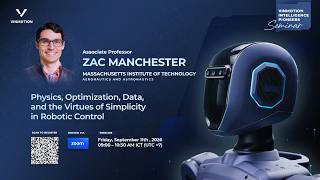
MIT associate professor Jack Manchester discusses how simple optimization, differentiable simulation, and compact control methods can support robotics across aquatic, terrestrial, and space applications, at a VinMotion seminar.
Amber Atherton, serial entrepreneur and investor at consumer-focused venture firm Patron, discusses specialized home robots and humanoids with John Koetsier on NEXT.