Steve Carlin, a SoftBank Robotics executive, joins the Nerdist hosts to discuss Pepper, practical uses for robots, and how technology can support human needs.
The hosts and Carlin consider whether automated tools, from self-tuning guitars to robots, change what counts as art. Carlin describes his path from geology and packaged goods into gaming, where he used shopper research to guide advertising placement and game artwork. He says retailers have only seconds to catch a shopper’s attention, so messaging needs to fit the person and the moment.
Carlin says people’s expectations of robots are shaped by science fiction, while current systems work best at specific tasks. Pepper was built to engage people in places such as malls, rather than navigate a complex store; mapping and sensors such as LiDAR could make that costly. He describes possible home uses connected to Internet of Things devices, while household chores such as picking up toys remain difficult.
Pepper can use facial cues as one input, and retailers could measure how many people pass, stop, and respond to a display. Carlin also describes Pepper guiding cruise ship guests, entertaining visitors, and supporting healthcare explanations and activities. Examples include helping dementia patients play games and explaining bone scans or MRI machines; he says the robot’s patience can help people feel more comfortable.
Carlin says SoftBank wants outside developers to build applications for Pepper, and compares the platform’s potential to early iPhone hardware. He notes that robot programs must account for physical limits such as gravity and motor strain. He also says children readily approach Pepper, high-five it, take selfies, and enjoy its simple dances.
Carlin says some people may find it easier to discuss PTSD recovery with a device than with another person, and argues that technology should meet human needs and add value. He expects robots to enter homes through practical use cases and connected devices, while emphasizing that technology can make tasks easier and leave more room for human experiences. His advice on marketing is to understand what matters to the audience and make the message relevant.
Briefs summarise talks and interviews; timestamps open the video at that moment. Claims in a talk are the speaker's own.
University of Tsukuba professor Fumihide Tanaka presents robotics research at the Paul G. Allen School, covering child-robot interaction, education, and social robots for older adults.
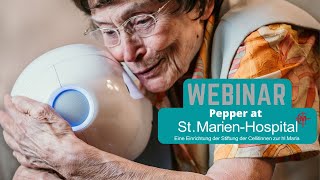
Professor R. Kim, a geriatrics specialist at St. Marien Hospital, and Alexander Paul of Entrance Robotics discuss using Pepper and Robot Care to support older patients, with host Nicholas at SoftBank Robotics Europe in Paris.
A SoftBank Robotics Europe Certified Partner from Robots of London discusses the company’s robot applications, a Pepper deployment for the GSMA at Mobile World Congress, and its expanding partnership with SoftBank Robotics.