David Reger, founder of Neura Robotics, joins the OMR Podcast to discuss building cognitive robots in Metzingen, growing the company, and his ambition to make Germany a global force in robotics.
A difficult start and an unexpected route into robotics
Reger describes growing up as the second-oldest of eleven siblings and struggling at school; he left without an Abitur and trained in foundry model making. After a year and a half working at a homeless shelter in San Francisco, he moved to Switzerland and joined MABI AG, where he learned robotics on the job and helped develop collaborative, industrial, and mobile robots.
Reger says dependence on suppliers was limiting innovation, so he set out to build robots that could sense and interpret their surroundings. After pursuing backing in Japan and China, he partnered with Han’s Laser’s founders and delivered an initial collaborative robot within three months. Neura’s first cognitive robot prototype followed seven months after the company began, with an early delivery to another manufacturer ten months in.
Scaling the company and resolving an investor impasse
Reger says Neura Robotics has 1,200 employees, is based in Metzingen, and supplies four of the world’s ten largest robot manufacturers. The company’s relationship with Chinese investors became difficult when capital could not be transferred to Germany under the applicable rules; Reger says he borrowed money and bought back rights before bringing in investors including Holtzbrinck Ventures, Lingotto, and Steven George. He reports an order backlog above €1 billion and a goal of €13 billion in sales by 2030.
Reger describes Neura’s core product as a platform for teaching robots through data, sensors, and AI, which he calls Physical AI. Cameras, fingertip touch sensors, and audio help robots respond to what they see, feel, and hear. He says a robot can learn a task such as folding a T-shirt in minutes or hours, and can adapt when a welding or assembly task differs from the expected pattern.
Industrial use, peaceful purpose, and Germany’s role
Reger expects humanoid robots to first help industrial employers facing labor shortages, by working in spaces already designed for people. He says Neura rejects defense contracts, even when offered large purchases, because the company is committed to peaceful uses. He argues that Germany needs to regain global relevance through technology and industrial capability.
Briefs summarise talks and interviews; timestamps open the video at that moment. Claims in a talk are the speaker's own.
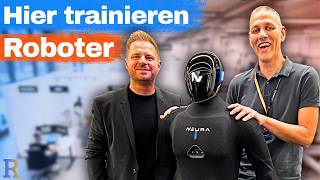
Jens Fischer, host of RoboSphäre, covers the opening of Neura Robotics’ robot training gym at Munich Airport with TUM, including remarks from Neura Robotics CEO David Reger and TUM representatives.
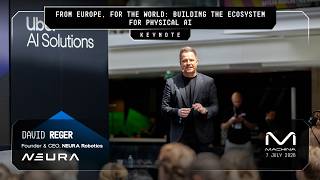
Neura Robotics founder and CEO David Reger explains his vision for physical AI and how the company is building robots, training tools and a shared platform at MACHINA 2026 with Machina Summit.
David Reger, founder and CEO of NEURA Robotics, discusses physical AI, robotics platforms, and open collaboration with John Furrier on SiliconANGLE theCUBE at Machina Summit in Paris.
David Reger, founder and CEO of NEURA Robotics, discusses the company’s humanoid plans, physical AI, industrial uses and how robots may fit alongside human workers with the host of Automation Awakenings at NEURA’s headquarters.