Claire Asher, host of Robot Talk, leads a live panel at Imperial College London with Science Museum curator Ben Russell, University of Hertfordshire robotics lecturer Mariam Banatalibbei Dordi, and Imperial College roboticist Petar Kormushev on why people build humanoid robots and where they may be useful.
Ben Russell traces humanlike machines from religious automatons and 17th-century writing and chess devices to industrial mechanisms and modern robots. He describes finding an early walking robot in a North London basement, and explains that Eccerobot was built to study how bodies shape the development of minds. Russell suggests that people build humanlike machines partly to investigate their own bodies and behavior.
Mariam Banatalibbei Dordi discusses humanoid robots for health care and education, including research on gaze and gestures to make interaction more comfortable for autistic children and people with dementia. A familiar shape may help people engage, but it can also raise expectations the robot cannot meet, creating awkward or unsettling interactions. Dordi says a robot's form should fit its purpose; many industrial jobs are better served by task-specific machines.
Petar Kormushev describes NERO, a 200-kilogram research robot equipped with sensors that measure its position and the forces it applies. His lab teaches skills through human demonstrations and imitation learning, while reinforcement learning lets robots improve through trial and error. Kormushev says transferring skills between robots remains difficult, and vision-language-action methods are still developing.
The panel weighs possible roles in care against concerns about safety around children, military uses, and the effects of relying on robots for social support. Russell questions whether humanoid designs are needed for many jobs, citing a practical mobility aid for people with dementia and a comforting robotic seal. He also points to the risks of a large robot falling if stopped, while the panel says adoption depends on public choice, affordability, and safer mechanics.
Briefs summarise talks and interviews; timestamps open the video at that moment. Claims in a talk are the speaker's own.
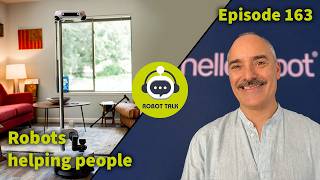
Aaron Edsinger, Hello Robot’s CEO and co-founder, talks with Claire Asher on Robot Talk about designing practical assistive robots, safety, and bringing Stretch into homes.
Allison Okamura, a Stanford University engineering professor, discusses human-centered robotics, haptic feedback, wearable devices, and soft robots for medicine, learning, and hazardous environments with Robot Talk host Claire Asher.
Rich Walker, director of Shadow Robot Company, discusses dexterous robot hands, their design trade-offs, and the challenges of bringing robotics into practical use with Robot Talk host Claire Asher.
Amir Patel, associate professor at University College London, discusses how robotics can reveal how cheetahs move and how those findings inform agile robots, wildlife monitoring, and animal health research with Robot Talk host Claire Asher.
Anuradha Ranasinghe, a robotics researcher at Liverpool Hope University, discusses tactile sensing and feedback for robots with Robot Talk host Claire Asher.