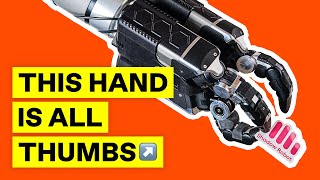
Rich Walker, director of Shadow Robot Company, discusses dexterous robot hands, their design trade-offs, and the challenges of bringing robotics into practical use with Robot Talk host Claire Asher.
Shadow Robot began as a 1980s hobbyist group building robots, then became a company in 1997 to take on engineering work. After developing a biped now in the Science Museum’s permanent collection, the team shifted its focus to robotic hands.
The company’s anthropomorphic hand was designed to match a human hand’s scale and range of movement, initially using pneumatic muscles and later a motor system. For Google DeepMind, Shadow Robot developed a non-human-like hand with three or four chunky fingers, designed to withstand collisions and support machine learning; Walker says it was tested with thousands of hours of impacts.
Walker says five fingers are not necessary for every task, though he cites biosafety work where keeping hold of a vial lid and a tool can make all fingers useful. He says dexterity is hard to define and that hand design involves trading actuator weight against strength, precision, and safety. Soft robotics can work well when a structure’s natural behavior suits the task, but precise control remains a challenge.
Walker says robotics is a set of tools that must be adapted to a customer’s real job, and early deployments can lose money while systems are refined. Adoption hubs, grants, and tax credits could help organizations manage that risk. He also cautions that humanoid form can make people assume a robot has human-level abilities, even when its software has not made comparable progress.
Briefs summarise talks and interviews; timestamps open the video at that moment. Claims in a talk are the speaker's own.
Rich Walker, director of Shadow Robot Company, presents at Humanoids Summit on designing durable, sensor-rich dexterous hands for robot learning and humanoid applications.
Rich Walker, director of Shadow Robot Company, describes the company’s new robotic hand at ICRA in Yokohama, including its design, sensing, and repairability.
Aaron Edsinger, Hello Robot’s CEO and co-founder, talks with Claire Asher on Robot Talk about designing practical assistive robots, safety, and bringing Stretch into homes.
Allison Okamura, a Stanford University engineering professor, discusses human-centered robotics, haptic feedback, wearable devices, and soft robots for medicine, learning, and hazardous environments with Robot Talk host Claire Asher.
Amir Patel, associate professor at University College London, discusses how robotics can reveal how cheetahs move and how those findings inform agile robots, wildlife monitoring, and animal health research with Robot Talk host Claire Asher.