NVIDIA· Oct 23, 2026
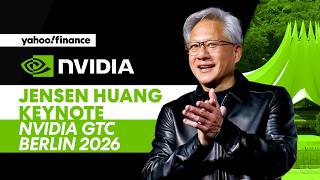
NVIDIA GTC Berlin 2026 Keynote With CEO Jensen Huang
NVIDIA founder and CEO Jensen Huang presents the company’s AI strategy and product announcements at GTC Berlin, with European partners and customers.
NVIDIA CEO Jensen Huang talks with the No Priors hosts about reasoning models, jobs, open source, robotics, AI infrastructure, and the case against the AI bubble narrative.
Huang says grounding, reasoning, and links to search have helped AI give more reliable answers. He argues that AI changes the tasks people do without necessarily eliminating the purpose of their jobs: radiologists, for example, can review more scans and help more patients. He also points to new jobs in chip, computer, and AI factory construction, as well as future robot maintenance.
Huang describes AI as a five-layer stack: energy, chips, infrastructure, models, and applications. He argues that open models let startups, universities, and established industries adapt AI to specialized needs, while closed models can still be valid businesses. He cautions against treating one company or one model as the sole path to national AI leadership.
Huang says hardware, algorithms, and model design together are driving large declines in AI costs, and that open research such as DeepSeek’s benefits labs and startups. He expects models and companies to specialize in areas such as coding rather than trying to excel at everything. Looking ahead, he highlights digital biology, including protein understanding and generation, and reasoning systems for cars and robots.
Huang expects reasoning and multimodal systems to help robots handle situations beyond their training, and says many forms of moving machinery could become robotic. He predicts more industry-specific AI solutions because physical systems need extremely high reliability. On the bubble question, he points to demand across accelerated computing, healthcare, finance, autonomous vehicles, and research, while arguing that infrastructure capacity and energy supply remain constraints.
Briefs summarise talks and interviews; timestamps open the video at that moment. Claims in a talk are the speaker's own.
NVIDIA founder and CEO Jensen Huang presents the company’s AI strategy and product announcements at GTC Berlin, with European partners and customers.
NVIDIA CEO Jensen Huang discusses Europe’s AI economy, NVIDIA’s AI infrastructure and agent platforms, and physical AI at GTC Berlin, with examples from European industry and NVIDIA partners.
Jensen Huang, NVIDIA’s CEO and founder, joins Lex Fridman in Taiwan during Computex to discuss the island’s engineering ecosystem, NVIDIA’s partnerships and AI infrastructure, and the value of cooperation amid competition.
Jensen Huang, CEO of Nvidia, describes how AI is being used inside the company and predicts that robotics will reshape factories; AI Explained host discusses these claims with robotics researcher Jason Ma and IPPR report author Carsten Young.
The host and main speaker from Robotics Central explains Kawasaki’s staged plan to deploy Kaleido humanoid robots, and how Japan’s AI funding, Nvidia computing, and human remote operators fit into that effort.
Amulia Vishban, founder of Techable Ventures, discusses investing in physical AI with Dominic Madori Davis on TechCrunch’s Equity podcast.