Huang says NVIDIA began by pairing sequential CPU work with parallel GPU processing, first for video game graphics. He describes CUDA as a way for researchers and programmers to use GPUs for other tasks, from medical imaging to scientific computing. He calls faster simulations a kind of time travel, because they let researchers explore results sooner.
Huang points to AlexNet, developed by Ilya Sutskever, Alex Krizhevsky, and Geoff Hinton, as a pivotal 2012 demonstration of neural networks trained on NVIDIA GPUs. He says the result led NVIDIA to redesign its computing stack around deep learning. His long-term bets, including CUDA, rested on the belief that larger models and more data could expand what AI can learn.
Abram describes how digital environments can give robots more training examples than physical trials alone. Huang says NVIDIA's Omniverse simulator and Cosmos world model can combine varied virtual scenarios with physics-based grounding, covering properties such as gravity and friction. He expects robots in cars, homes, factories, and other settings, and imagines a personal assistant like R2-D2 available across devices.
Huang names risks including bias, hallucinations, impersonation, and failures in systems such as self-driving cars. He argues safety requires engineering, redundancy, and surrounding systems that reduce harm when AI or machinery fails. He also cites energy efficiency as a key computing constraint and points to NVIDIA's work on robotics, digital biology, and regional climate prediction.
Huang suggests considering how work and daily life might change if some tasks become nearly instantaneous, much as highways created new industries and ways of living. He recommends using AI as a tutor and learning how to apply it to one's profession. He compares this shift with his generation learning to use computers at work.
Briefs summarise talks and interviews; timestamps open the video at that moment. Claims in a talk are the speaker's own.
CNBC examines Nvidia, Jensen Huang’s reported relationships and leadership, the company’s path from PC graphics to AI computing, and the business and geopolitical risks facing the company.
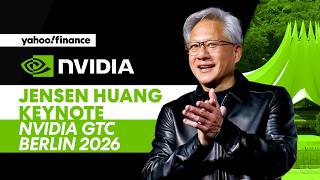
NVIDIA CEO Jensen Huang discusses Europe’s AI economy, NVIDIA’s AI infrastructure and agent platforms, and physical AI at GTC Berlin, with examples from European industry and NVIDIA partners.
Jensen Huang, NVIDIA’s CEO and founder, joins Lex Fridman in Taiwan during Computex to discuss the island’s engineering ecosystem, NVIDIA’s partnerships and AI infrastructure, and the value of cooperation amid competition.
NVIDIA founder and CEO Jensen Huang presents the company’s AI platforms, systems and ecosystem at GTC 2026, with partners and customers across cloud, enterprise and robotics.
NVIDIA CEO Jensen Huang presents the company’s AI computing platforms and ecosystem at GTC, covering data processing, AI factories, agentic software, and robotics.