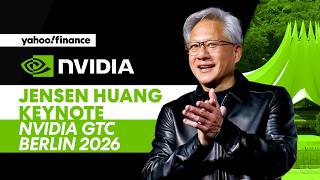
NVIDIA founder and CEO Jensen Huang presents the company’s AI platforms, systems and ecosystem at GTC 2026, with partners and customers across cloud, enterprise and robotics.
Huang marks 20 years of CUDA and describes how its developer base, libraries and compatibility help sustain NVIDIA’s ecosystem. He connects GeForce and programmable shaders to CUDA, deep learning and the rise of modern AI, then introduces neural rendering with DLSS 5 as a blend of 3D graphics and generative AI.
Huang argues that AI needs access to both structured business data and unstructured material such as PDFs, videos and speech. He highlights NVIDIA’s cuDF and cuVS libraries, citing IBM watsonx.data running Nestlé’s data mart five times faster at 83% lower cost, and Snapchat workloads on Google Cloud seeing costs fall nearly 80%. He describes NVIDIA as vertically integrated while keeping its technology open to other platforms.
Huang traces the shift from generative AI to reasoning and tool-using agents, saying each drives more inference and compute demand. He raises his estimate of high-confidence Blackwell and Rubin demand from $500 billion through 2026 to at least $1 trillion through 2027. He frames power-limited data centers as token-producing factories and presents Vera Rubin with Groq as a way to increase throughput and serve high-speed inference workloads.
Huang presents OpenClaw as an open framework for personal agents and NemoClaw as an NVIDIA reference design for enterprise privacy and security. He discusses NVIDIA’s Nemotron, Cosmos, GR00T, BioNeMo, Alpamayo and Earth-2 model families, plus a Nemotron coalition that includes Mistral, Cursor, LangChain and Perplexity. For robotics, he describes Isaac Lab, Newton and Cosmos for simulation and training, announces robotaxi partnerships with BYD, Hyundai, Nissan, Geely and Uber, and brings out Disney’s Olaf robot.
Huang introduces NVIDIA DSX, an Omniverse digital twin platform for designing and operating AI factories. The system brings together physical and electrical simulation, power management and operational data, with partners including Siemens, Cadence, PTC, Dassault Systèmes and Jacobs. Huang says digital twins and coordinated infrastructure management can improve energy efficiency and token throughput.
Briefs summarise talks and interviews; timestamps open the video at that moment. Claims in a talk are the speaker's own.
CNBC examines Nvidia, Jensen Huang’s reported relationships and leadership, the company’s path from PC graphics to AI computing, and the business and geopolitical risks facing the company.
NVIDIA CEO Jensen Huang discusses Europe’s AI economy, NVIDIA’s AI infrastructure and agent platforms, and physical AI at GTC Berlin, with examples from European industry and NVIDIA partners.
Jensen Huang, NVIDIA’s CEO and founder, joins Lex Fridman in Taiwan during Computex to discuss the island’s engineering ecosystem, NVIDIA’s partnerships and AI infrastructure, and the value of cooperation amid competition.
NVIDIA CEO Jensen Huang presents the company’s AI computing platforms and ecosystem at GTC, covering data processing, AI factories, agentic software, and robotics.
NVIDIA CEO Jensen Huang talks with the No Priors hosts about reasoning models, jobs, open source, robotics, AI infrastructure, and the case against the AI bubble narrative.