
Over The Horizon· Mar 24, 2026
Kyber Labs Just Ran a Real Pathology Lab Workflow
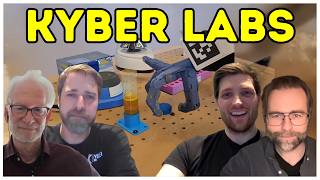
Jonathan and Tyler of Kyber Labs discuss automating clinical pathology workflows with Scott Walter and Gustav Anderson on Over The Horizon.
Kyber Labs co-founder Tyler Habalski joins Over The Horizon’s host, Scott Walter, and Gustav Anderson to explain the company’s tendon-driven robot hand, its design choices, and plans for industrial use.
Walter and Anderson estimate the hand has 20 degrees of freedom and discuss how its thumb, finger joints, and abduction work. Habalski confirms 20 degrees of freedom and 40 tendons, with dedicated tendons for flexion and abduction. He says independent finger control helps the team know each fingertip’s position without adding sensors to the fingers.
Habalski says the forearm contains 20 frameless brushless motors, built in-house from magnets and coils to balance cost, torque, and heat management. The motors’ position sensors are the hand’s only sensors; rising drive current as a motor encounters resistance helps detect contact. The team uses motor feedback to compensate for tendon slack, and says its split-finger construction makes tendons easier to access and service.
Kyber Labs is developing a modular hand-based platform for assembly, maintenance, and logistics, rather than building a complete humanoid robot. Habalski points to tasks such as assembling parts at a desk, handling bins, and tending machines, where a versatile hand could reduce reliance on specialized grippers or human assistance. He says the company is evaluating whether it needs a wrist and wants to avoid adding hardware before use cases require it.
Habalski says Kyber Labs is preparing for seed fundraising and has prospective customers with defined applications. The company plans to begin pilots in 2026 and offer about 50 hands as grants to research groups. Its software plan combines scripted tasks with machine learning for harder, specific actions, with the aim of carrying useful research into industrial deployments.
Habalski describes grip strength as roughly human-like, with sustained performance limited by heat. He says the shared metal structure helps distribute heat across the motors and keeps the system compact and less costly. The team is building much of the system in-house, while sourcing magnets from China and currently manufacturing overseas to iterate quickly.
Briefs summarise talks and interviews; timestamps open the video at that moment. Claims in a talk are the speaker's own.
Jonathan and Tyler of Kyber Labs discuss automating clinical pathology workflows with Scott Walter and Gustav Anderson on Over The Horizon.
RoboStrategy head of research Scott Walter, an aerospace engineer and robotics-company co-founder, joins host Herbert to discuss Tesla Optimus V3’s design, production readiness, and remaining engineering challenges.
Scott Walter, a robotics engineer and advisor, joins Over The Horizon hosts and guests to discuss Sharpa’s Dairy Queen deployment, Mimic’s dexterous hand, and Sunday Robotics’ home laundry results.
Host and robotics analysts Scott Walter, Devang Adhyaru of the Humanoid Hub, Gustav, and Merdad examine 1X Technologies’ Neo hand and its mechanical design, demonstrations, and remaining uncertainties.
Armin Foshnaughski of Munro & Associates, Schaeffler’s Al Mackie and Paul, and Scott Walter of RoboStrategy discuss the Unitree G1’s design and humanoid robotics during a Munro teardown.
Scott Walter joins The Humanoid Hub host to analyze Tesla’s Optimus hand and production plans, Figure’s robot output, and humanoid robots’ performance in the Beijing half marathon.


