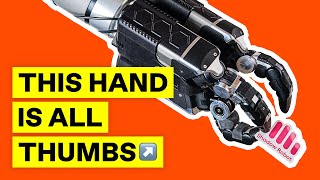
Rich Walker, director of Shadow Robot Company, presents at Humanoids Summit on designing durable, sensor-rich dexterous hands for robot learning and humanoid applications.
Walker says dexterous manipulation is hard to define, but learning it in the real world requires abundant sensor data, tolerance for collisions, long operating times, and high dexterity. Shadow built a hand about 50% larger than a human hand, prioritizing reliability and repairability over human-like size and shape.
The hand uses N+1 actuation, with one more motor than joints, for controlled movement without backlash. Its three fingers combine stereo optical touch sensors at the tips with Hall effect sensors along the finger surfaces; each phalanx also has an IMU. Walker says three fingers are enough for tasks that involve holding and manipulating an object.
Shadow spent about three years testing the hand through repeated impacts, random movement, and mallet strikes, while building diagnostics and maintenance tools. The system streams substantial sensor data, runs force control at 10 kHz, and offers ROS support and an open API. Walker says DeepMind has a group of the hands and has used them in work combining demonstrations with learning.
Walker frames humanoid development as a balance between agile movement, dexterity, usefulness, and safety. He says software advances have expanded what the hardware can do, while durable, slim, human-like hands remain an engineering challenge. Shadow announced its Upward and Ogres projects with £11 million in ARIA funding to investigate hand design, actuation, and control.
Asked about sensor scale, Walker says durable skin that crosses joints and seals them remains difficult; current sensors fit flatter, unchanging surfaces. He says hand trade-offs depend on the application, and that robust systems have drawn interest from industrial organizations seeking to automate tasks their existing equipment cannot handle.
Briefs summarise talks and interviews; timestamps open the video at that moment. Claims in a talk are the speaker's own.
Rich Walker, director of Shadow Robot Company, discusses dexterous robot hands, their design trade-offs, and the challenges of bringing robotics into practical use with Robot Talk host Claire Asher.
Rich Walker, director of Shadow Robot Company, describes the company’s new robotic hand at ICRA in Yokohama, including its design, sensing, and repairability.