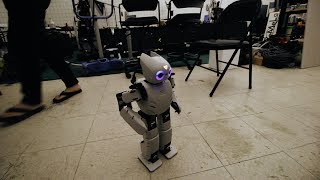
Hong says humanoid robots can be unstable, slow, costly, complex, and hazardous around people. He traces these problems to the twisting forces created by forward-facing legs, then introduces NABi, a non-human-shaped biped that walks sideways for simpler, faster movement. Its rotating knees also help it handle shipboard door seals and stairs.
NABi can hop using springy feet, but it cannot turn. ALPHRED addresses that limit with a symmetric four-legged design that can walk in a wide stance, gallop when reconfigured, or use two legs as arms. Hong calls this multimodal locomotion.
Hong contrasts conventional geared electric motors with the BEAR actuator, designed to provide spring-like compliance and control of force as well as position. With BEAR, NABi-2 became capable of directional jumps and could recover some landing impact as electricity. ALPHRED-2 demonstrated fast walking, a jump of about 1.4 meters, taekwondo moves, and box handling.
The six-legged HEX uses three-point ground contact for stability in rough terrain and is being developed for autonomous landmine removal. Smaller SiLVIA can climb stairs, brace between walls, and climb with suction cups. SCALER uses spine grippers for cable-free climbing, with potential to reach cliff sites on Mars that rovers cannot access.
OmBURo is a single-wheel robot that moves in any direction and balances on steep surfaces, while its narrow profile suits crowded spaces. BALLU uses a helium balloon for a lightweight, human-sized biped that can walk, hop, dance, and even cross water with ping-pong balls attached to its feet; wind makes outdoor use difficult. Hong also previews ARTEMIS, a humanoid robot built around the BEAR actuator technology.
Briefs summarise talks and interviews; timestamps open the video at that moment. Claims in a talk are the speaker's own.
Dr. Dennis Hong of Virginia Tech presents the DARwIn-OP humanoid robot, its development and research goals, alongside collaborators at Purdue, the University of Pennsylvania, and ROBOTIS.
Dennis Hong, robotics professor and founding director at Virginia Tech, explains why humanoid robots suit human environments and how his lab developed soccer-playing robots and firefighting prototypes.
The Summer Nomad host discusses a student robotics team’s competition results, lessons from losing, a UCLA RoMeLa Lab visit, and a tournament at Google with students from 729 AMI Robotics.