AiNews· May 14, 2025
AiNews.com Interview with Leo Ma, Founder and CEO of RoboForce
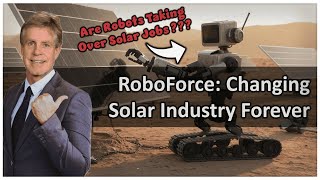
Leo Ma, founder and CEO of RoboForce, discusses AI-powered robot labor for hazardous and labor-constrained work with Alicia Shapiro on AiNews.com.
Leo Ma, founder and CEO of RoboForce, joins Dexmate CEO Tal Chen and UCSC robotics professor Steve Maguire for a discussion of embodied AI, robotics deployment, and human safety at SF Tech Week with moderator Professor Tamingh.
Steve Maguire describes using robotics in agriculture and ecology, including planning wireless sensor placement across farm fields and accounting for the sensors’ full life cycle. Tal Chen says Dexmate is building reusable technology to make robotics applications easier to create. Leo Ma says RoboForce aims to automate dangerous, repetitive work, including jobs at large solar sites.
Maguire says agricultural AI needs labeled data that covers natural variation, but collecting it is costly and some disease cases cannot be ethically created for research. Ma says RoboForce has moved past some model and system hurdles, while customer adoption and supply-chain capacity remain constraints. He cites more than 35 early customer partners across 12 countries and orders for over 11,000 systems, alongside a hardware design with 15 subsystems and 660 components.
Maguire sees language models as useful research and coding assistants, while stressing that students need to learn when their output can be trusted. Chen describes training robotics models with large datasets from teleoperation, simulation, and human demonstrations, then adapting them to specific tasks and hardware. The panel sees foundation models as a way to reduce customer-specific development, but Ma emphasizes that customers need reliable performance more than broad generalization alone.
The panel argues that robot shape should match the job: wheels, humanoid bodies, and other designs each suit different settings. Chen says a limited range of hardware designs can help control cost, while common software and AI layers can support multiple forms. Panelists also note that humanlike appearance may help acceptance in care settings, and that robots can signal intended movement to make nearby people feel safer.
Panelists describe safety as a combination of predictable motion, force sensing, collision monitoring, and safe training data. Ma says RoboForce aims to keep people out of hazardous work sites such as remote solar projects and data-center construction areas. On simulation, Maguire favors physical models when the underlying science is understood, while Chen says teams should choose simulation or real-world data according to the task and its cost.
Briefs summarise talks and interviews; timestamps open the video at that moment. Claims in a talk are the speaker's own.
Leo Ma, founder and CEO of RoboForce, discusses AI-powered robot labor for hazardous and labor-constrained work with Alicia Shapiro on AiNews.com.
Leo Ma, founder and CEO of RoboForce, and Varil Hard, who leads business development, discuss outdoor industrial robots for solar installation with Sean White at Intersolar North America in San Diego.